When a Digital Duty of Care Becomes Lipstick on a Pig: Policy Sequencing, Market Logic, and the Importance of a Theory of Change

We want the internet to be safer. For our kids. For ourselves. We want to communicate, find information, collaborate, create, share, engage, participate and have fun. We want to seek out what we need — including the full range of adult content that adults have always sought — in ways that are appropriate to who we are and where we are in our lives. We want age-appropriate access that doesn’t require us to hand over our passports to every platform we visit. We want the architectural conditions of digital life to be designed for human flourishing rather than engineered for compulsive use. And we don’t want the solution to these problems to be a surveillance infrastructure that violates the privacy rights it claims to protect.

These are not unreasonable things to want. They are, in fact, the things that good digital regulation should deliver.

But there is something more specific underneath all of this. We want digital environments that lean toward a caring orientation. Spaces where the default assumption is that users are people with complex needs, relationships, vulnerabilities and capacities — not attention units to be harvested. Where the architecture of the platform supports human connection rather than exploiting it. Where the experience of being online doesn’t require constant vigilance against the system that is supposed to be serving you.

That is the design brief. And almost nothing about the regulatory choices being made right now — in Australia, in Europe, in the UK, and across the globe — is actually building toward it.

Person wearing pig mask applying red lipstick and taking a selfie in office cubicle
Image: AI generated image riffing off the lipstick on a pig concept. No animals were harmed in the making.

The Market Logic Nobody Wants to Name

Before getting to the policy failures, it is worth being precise about why they keep happening. The answer lies in market logic that is so entrenched, so global, and so structurally opposed to a caring orientation that no single national regulatory instrument can adequately address it.

The incumbent platforms — Meta, TikTok, Google, Snap — are not primarily communication services that have some problematic features. They are attention extraction machines that have communication as a byproduct. The product is engagement. The inventory is human time and psychological state. The business model optimises for the time users spend in states of arousal, comparison, compulsive return, and social anxiety — because those states generate the engagement signals that drive advertising revenue.

Every design feature that has been identified as harmful — infinite scroll, algorithmic recommendation, social feedback loops, disappearing content, notification systems, engagement-maximising AI — is not incidental to how these platforms make money. It is how they make money. The harm is the business model. The architecture that exploits developing brains is the same architecture that generates billions in revenue. Internal corporate communications — made visible through litigation processes rather than through corporate transparency — show that companies knew this and chose not to adequately address it. This is evidence of deliberate design intent, not corporate negligence.

Regulation that doesn’t change this underlying market logic doesn’t address the problem. An age ban doesn’t change the market logic — it removes a demographic without reforming the architecture that exploits them. Age verification doesn’t change the market logic — it adds a compliance cost that large platforms absorb and small competitors cannot. Even design obligations only change the market logic if the penalties make harmful features more expensive than the revenue they generate. For Meta, whose annual global revenue exceeded USD200 billion in 2025, a flat AUD49.5 million fine — Australia’s maximum penalty — is a rounding error. It does not change the calculation.

This is why the financial structure of regulation is not a technical detail. It is the mechanism by which regulation actually changes what the market produces. Penalties proportionate to global turnover — 5% to 10% — make the cost of harmful architecture real in a way that flat caps never can. Design obligations without proportionate penalties are aspirations. Design obligations with proportionate penalties are market signals.

The global reach of these platforms makes this harder still. TikTok’s recommendation algorithm is trained on engagement data from over a billion users across every jurisdiction. Meta’s systems don’t differentiate by country. A platform regulated to remove infinite scroll in Germany still has infinite scroll optimised on data from 3 billion users elsewhere. A national design obligation is a local intervention in a global architecture. This is why harmonisation matters — not just for legal coherence, but for actual effectiveness. The European Digital Services Act‘s harmonised framework, with Commission-level enforcement against Very Large Online Platforms, is structurally more capable of changing the market logic than any national ban. But only if it is designed with the financial penalties and design obligations that make compliance cheaper than non-compliance, and only if it is consistently enforced.

The attention extraction economy also produces a specific kind of competitive moat. The more data a platform has, the better its recommendation system. The better its recommendation system, the more engaging the platform. The more engaging the platform, the more users it attracts. The more users it attracts, the more data it has. This is a self-reinforcing loop that incumbents have been running for fifteen years. Regulation that adds compliance costs without breaking that loop entrenches incumbents rather than challenging them — because large platforms can absorb the compliance cost while smaller competitors cannot build the alternative at scale.

What the Australian Social Media Age Ban Has Taught Us

Australia’s Social Media Minimum Age Act came into force on 10 December 2025, banning children under 16 from holding accounts on designated social media platforms. It was the world’s first such ban. It passed in the last sitting week of 2024, introduced and passed within eight days, with a 24-hour public submission period that received 15,000 submissions, of which only 107 were published. This expedited process occurred shortly before a federal election that was called four months later in March 2025. FOI correspondence reported by Crikey and analysed by researcher Amanda Third showed the national Social Media Summit was designed to “build momentum for a decision already made,” not to deliberate on evidence. The political momentum was performative — the instrument was chosen for its communicative power rather than its causal effectiveness.

Six months in, the picture is clear.

The ban is not working on its own terms. The Molly Rose Foundation’s survey of 1,050 Australian 12-15 year-olds found 61% of those who previously had accounts on restricted platforms still have access to at least one active account. Among those still accessing banned platforms, 60-64% said the platform had taken no action to remove their account. The dominant story is not children cleverly circumventing the ban. It is platforms failing to comply.

The harm measures haven’t moved. The eSafety Commissioner’s own compliance report found no measurable drop in cyberbullying or image-based abuse complaints from children under 16 in the first three months of enforcement. These are the direct harm measures the ban was designed to move. They haven’t moved. Because the harm is in the architecture. And the architecture hasn’t changed.

Children were not consulted. The policy was designed by adults, about children, driven by adult anxieties, in a process that made meaningful child participation structurally impossible. A FOSI survey conducted in December 2025 found 65% of Australian parents support the ban — but only 38% of Australian children did. 56% of children said they feared losing important connections and support. The recent EU Kids Online network’s survey of 29,169 children across 19 European countries found 45% disagree that an age ban would make them safer online. Children knew this wouldn’t work. Nobody adequately asked them. They just became media soundbites.

Vulnerable children have been made less safe. Teenagers who bypassed the ban by appearing as adults lost the safety features platforms built specifically for teen accounts. The children most likely to circumvent the ban — the most determined, often the most vulnerable — have been stripped of the protections designed for them.

The ban was built on the wrong argument. It was passed on a mental health narrative — the claim that social media is the primary driver of the youth mental health crisis. That causal claim was contested in the peer-reviewed literature at the time of enactment and remains contested. The government has since quietly shifted the rationale — writing recommender algorithms and endless-feed features into the legal definition of a harmful platform — without acknowledging it. The shift is correct: the harm is in the design architecture. But arriving at the right argument after passing the wrong instrument doesn’t fix the instrument.

The Social Adoption Curve and the Workaround Economy

Regulation that ignores how people actually behave in response to restrictions will consistently produce outcomes it didn’t intend. The social adoption curve — how technologies spread through populations, become embedded in social norms, and resist displacement — is not a peripheral consideration for digital regulation. It is central to whether regulation achieves anything.

The NBER working paper surveying 835 Australian teenagers four months after the ban found that only about one in four 14-15 year-olds comply. Most banned teens believe their peers are still using platforms and cite social reasons for continuing. Teenagers reported they would need roughly two-thirds of their peers to stop using social media before they themselves would stop — far above the share currently complying. The more influential teenagers disproportionately stay on the platforms. The ban hasn’t shifted the social norm, and without that shift, legal prohibition alone cannot move behaviour.

This is not a failure of enforcement. It is a failure to understand how social technologies become embedded in the texture of everyday life. Social media is not a product that teenagers chose from a range of alternatives. For many, it is the primary infrastructure of peer connection, social identity, cultural participation, and information access. Removing it without providing alternatives — without investing in digital literacy, without creating safer spaces, without engaging with the social dynamics that make these platforms so central — is like removing a road and expecting people not to find another route.

The workarounds don’t just circumvent the regulation. They route around the safety infrastructure too. When teenagers bypass the ban they don’t find a safer internet. They find Discord servers, Reddit threads, private WhatsApp groups, and gaming platforms — all less moderated, less visible to adults, and more opaque to regulatory oversight. The Molly Rose Foundation data shows 43% of children are using gaming platforms more and 39% are using messaging apps more since the ban. These spaces are not covered by the ban, have weaker safety systems, and are harder for researchers, regulators, and parents to monitor. The unintended consequence of the ban has been to push children’s online activity into less regulated environments while maintaining the fiction that they are protected.

Social norm change does happen — and when it does, it can be powerful. But the evidence from decades of public health research suggests that norm change is produced by education, social modelling, environmental design, and cultural shift — not by prohibition that lacks meaningful enforcement and ignores the social dynamics that make the prohibited behaviour attractive. The ban cannot shift the norm because it doesn’t address why the platforms are so central to teenagers’ social lives in the first place. That is a design problem. And design is what the ban doesn’t touch.

The Age Verification Architecture: Surveillance by Another Name

The ban’s enforcement depends on platforms verifying users’ ages. Australia’s law requires “reasonable steps” without specifying what those steps must be, and mandates that verification data be deleted once its purpose is served.

In practice, platforms deployed a patchwork of unreliable methods. Facial recognition proved wildly inaccurate near the 16-year threshold. The government’s own age assurance technology trial found that no single solution suits all use cases — and that some vendors were proactively retaining biometric and identity data beyond legal requirements, anticipating future law enforcement or regulatory requests that didn’t yet exist. This is surveillance creep in documented, real-world form. The legislation required deletion. Vendors were building retention infrastructure instead.

The attack surface problem is structural. Every mandatory age verification requirement creates a chain of custody for sensitive identity information. Every link in that chain is vulnerable. The Discord breach of September 2025 — in which government identity documents submitted for age verification were accessed through a compromised third-party provider — illustrated exactly what mandatory verification creates. Third-party age assurance providers don’t just become attack vectors. They become commercially entrenched ones, with incentives to retain rather than delete the data they process.

There is also a fundamental confusion in the verification approach between identification and safety. Safety is a property of environments. Identification is a property of users. Making an environment safe does not require knowing who is in it. Article 28(3) of the EU’s Digital Services Act makes this explicit: compliance with child safety obligations “shall not oblige providers of online platforms to process additional personal data in order to assess whether the recipient of the service is a minor.” Europe’s primary platform safety instrument explicitly says you do not need identity verification infrastructure to protect children. The design obligation can be met through architecture, not identification.

The identification-surveillance-rights tension cannot be resolved within the verification framework. It can only be dissolved by the design framework, which doesn’t require it. If platforms are required to make their services safe by design for everyone, the question of who users are becomes largely irrelevant to the regulatory obligation.

The Kitchen Sink Problem: Two Instruments in Operation, One Horse Being Backed

Australia has two regulatory instruments already in operation that are pulling in opposite directions — and a third that the government is now hastily backing as the evidence mounts that the first two are seemingly in conflict with their desired outcomes, but rapidly servicing an economic boon in age assurance technologies.

The age ban says under-16s should not be on restricted platforms — access control through exclusion. It is being enforced now, with formal investigations underway against five major platforms.

The Phase 2 industry codes extend age assurance obligations across the commercial internet infrastructure that most Australians use daily — social media, messaging, gaming, search engines, hosting platforms, app stores, and operating systems. Surveillance architecture through identity verification at every layer of digital life. Already being implemented. Commercial infrastructure being built around it now.

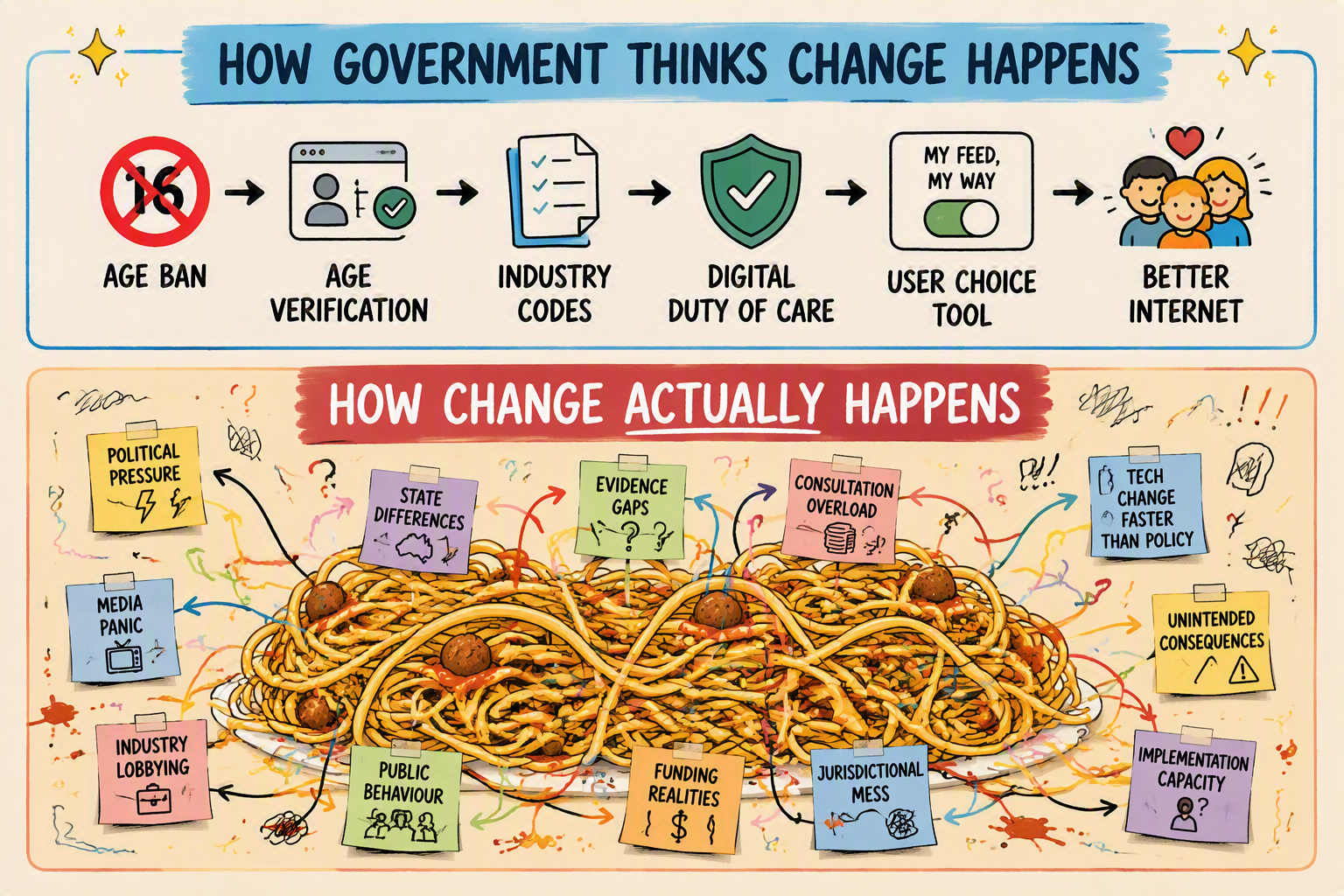
These two instruments share a theory of change: identify users → gate by age → safety through exclusion and verification. They are the horses that won the race to be saddled first.

The Digital Duty of Care is the horse now being backed after the race has started. Released as an issues paper for consultation in May 2026 — eighteen months after the ban passed — it proposes that platforms must maintain safe environments through effective systems and processes, covering the entire commercial internet infrastructure that most Australians use daily: social media, messaging, gaming, search engines, hosting services, app stores, internet service providers, equipment and operating systems, and generative AI capabilities embedded in service provision. It has a fundamentally different theory of change: design safe environments → safety through architecture.

It is not legislation. It is not law. It is a consultation document that may or may not become legislation, that if it becomes legislation will commence no earlier than 2028, into a regulatory environment where the surveillance architecture will have had three or four years of commercial entrenchment. Whether it actually passes is uncertain. Whether it retains its ambition through consultation, drafting, parliamentary debate, and an election cycle is more uncertain still. The government that releases issues papers is not the same thing as a government that passes legislation — as Australia’s stalled gambling reform, its undelivered media bargaining code amendments, and a dozen other promised instruments demonstrate.

What is certain is that the Safety-by-Design angle of the Duty of Care cannot be coherent alongside the instruments that arrived before it. The ban removed under-16s as a regulatory lever — platforms no longer have a commercial relationship with that demographic, so design obligations for that age group have no market teeth. The industry codes built identity verification infrastructure across the entire internet stack before the design obligation existed to challenge it. By the time the Duty of Care arrives — if it arrives — the surveillance architecture will be the established compliance baseline and the design obligation will accommodate itself to that baseline rather than replacing it.

The first two instruments share a theory of change that is incompatible with the third. No amount of drafting ingenuity can resolve that incompatibility because it is not a drafting problem. It is a sequencing problem. And sequencing problems cannot be fixed retroactively.

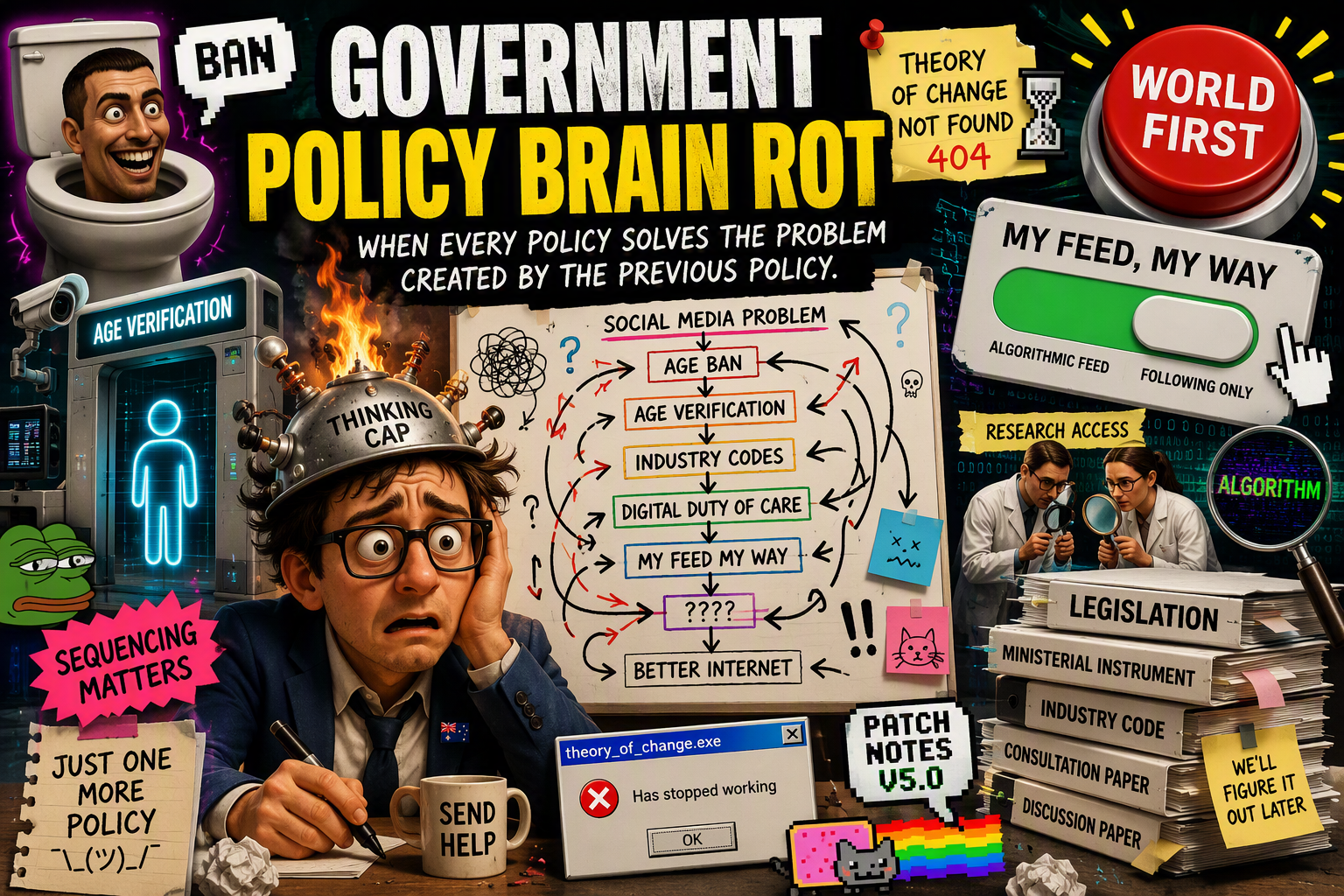
This is what happens when policy is made reactively, under political pressure, without a coherent theory of change. The ban for electoral momentum. The industry codes for the enforcement gap the ban couldn’t address. The Duty of Care for the evidence gap the ban made visible — a gap that the evidence predicted before the ban passed and that the compliance data has since confirmed. Each instrument designed in response to a different political moment, without knowledge of the others, building infrastructure that points in opposite directions.

The kitchen sink approach feels comprehensive. It is, in fact, incoherent — and nobody in the political process is stepping back to ask what theory of change actually connects any of this to children being safer.

The Senate committee that passed the ban knew it was insufficient. In the same report, it recommended a Digital Duty of Care, meaningful engagement with young people, and an independent review within 18 months. Eighteen months later, the Duty of Care is still only an issues paper, children were not meaningfully consulted, and the compliance data has confirmed what the committee already knew: the ban alone was not enough.

First Mover Entrenchment: Why the Wrong Instrument Wins

The sequencing problem is worse than a policy mistake. It is a policy mistake that forecloses correction.

Regulatory infrastructure creates commercial ecosystems. Commercial ecosystems create incumbents. Incumbents invest in maintaining their position. Regulators incorporate incumbent frameworks into compliance standards. Compliance standards become the definition of reasonable steps. The alternative has to fight the established definition rather than starting from first principles.

The age assurance industry had a structural commercial interest in the Australian ban passing. Without mandatory verification requirements their market is voluntary and limited. With mandatory requirements — extended through Phase 2 industry codes across the entire internet stack — they have a legislatively mandated, expanding global market. The cascade of age ban legislation following Australia is, from their perspective, a commercial opportunity of extraordinary scale. Every new jurisdiction that follows Australia is a new market.

The trial dynamic illustrates the problem precisely. The Australian age assurance technology trial was run by the Age Check Certification Scheme — a UK-based company that specialises in certifying identity verification systems. The 53 vendors who participated were hoping to win contracts. Yoti — one of those vendors — was simultaneously already operating as Meta’s age verification provider for Instagram and Facebook in Australia. The trial was partly evaluating a vendor that was already commercially embedded in the platform being regulated.

Meta’s participation in the trial was not a technology submission — it was a policy position paper arguing that Apple and Google should bear the age verification infrastructure burden at the operating system level. A platform being regulated used a technology evaluation process to argue someone else should build the infrastructure.

By the time the Digital Duty of Care might commence — 2028 at the absolute earliest — the age assurance industry will have had three or four years of commercial entrenchment. The ACCS accreditation framework will be established. Trusted provider lists will be published. Yoti, k-ID, and whoever else made the cut will have multi-year contracts with major platforms. The regulatory definition of “reasonable steps” will have been shaped by the infrastructure that already exists — which is surveillance-based, not design-based.

The Duty of Care arriving into that environment does not displace the surveillance architecture. It layers design obligations on top of it. Platforms satisfy their risk assessments by pointing to their age assurance compliance. Design-based safety becomes an aspiration accommodated within the surveillance infrastructure it was supposed to replace.

This is the lipstick. The pig is already there.

The Market Foreclosure Nobody Is Talking About

Building expensive surveillance infrastructure as the baseline compliance requirement for operating digital services locks out the competitive innovation ecosystem that could produce the alternatives we actually need.

Age verification at scale requires technical capability, regulatory accreditation, legal compliance across jurisdictions, and ongoing operational infrastructure. These requirements favour large, well-resourced incumbents who can absorb compliance costs. They disadvantage smaller players who might otherwise develop genuinely safer localised alternatives — platforms designed from first principles around user wellbeing rather than engagement maximisation, community-governed spaces, federated architectures, open-source tools, cooperative models.

A small company building a genuinely caring social platform for young people cannot afford the age verification infrastructure required to operate legally under the industry codes. The incumbent platforms — Meta, TikTok, Google — can. The regulatory requirement that was supposed to hold them accountable instead reinforces their monopoly position. This is not an incidental side effect. It is a predictable consequence of designing compliance infrastructure around the capabilities of the largest players.

The attention extraction economy already has a massive first-mover advantage built on fifteen years of engagement data, network effects, and platform lock-in. Surveillance-based compliance requirements compound that advantage. They create regulatory moats around incumbents that make it structurally harder for new entrants to compete — even new entrants with better, safer, more caring designs.

This matters because market competition, properly structured, is a more powerful mechanism for improving platform safety than any single regulatory instrument. If a platform with a genuinely caring orientation — one that doesn’t exploit users, builds in natural stopping points, recommends content for user want rather than engagement maximisation — can compete effectively with Meta and TikTok, the incumbents face pressure to match it. If the regulatory architecture makes it impossible for that platform to exist, the pressure disappears and the incumbents have no incentive to change.

The caring orientation we want from digital environments is more likely to emerge from a diverse, competitive innovation ecosystem than from regulatory mandates on entrenched monopolists. Mandates matter — but they work best when they operate alongside competitive pressure that makes compliance in the spirit of the regulation commercially rational, not just legally required.

What the Duty of Care Gets Right — And Why It Arrived Too Late

The Australian Digital Duty of Care issues paper is, on its own terms, a well-designed framework. It is worth being clear about what it gets right, because the argument here is not that the Duty of Care is wrong. It is that it arrived too late, in the wrong sequence, into an environment that has already foreclosed much of its potential.

It proposes design obligations covering the commercial internet infrastructure Australian’s access — including generative AI capabilities embedded in service provision. This is genuinely forward-looking. Generative AI is no longer just a discrete tool that users consciously choose to engage with. It is disappearing into the infrastructure of everyday digital experience — embedded in recommendation systems, content generation, conversational interfaces, image manipulation, synthetic social interaction. The harm is becoming invisible precisely as it becomes more pervasive. A regulatory framework that covers AI as it is actually deployed, rather than as a separate product category, is the only framework that can keep pace with that technological shift.

It proposes penalties of up to 5% of global annual turnover, with a floor of AUD50 million — proportionate, not performative. For Meta, 5% of global turnover would be in USD billions. That is a different conversation entirely from the ban’s maximum penalty — currently equivalent to approximately AUD $49.5 million — which for the largest platforms amounts to a calculable cost of doing business rather than a genuine deterrent.

It proposes researcher data access, independent audit powers, transparency requirements, and executive accountability. These are the instruments of ongoing accountability rather than one-time compliance. They create the evidence base that regulatory decisions require and the governance structure that makes accountability real rather than performative.

This is, essentially, what Australia should have passed instead of the ban. It is what Zoe Daniel’s Digital Duty of Care Bill introduced on 25 November 2024 — four days after the social media ban was tabled, lapsing when Daniel lost her seat in the federal election. The right framework existed. The wrong instrument passed instead.

But the Duty of Care is still only an issues paper. Not legislation. Not law. Pre-consultation, with no timetable for introduction, no guarantee of passage, and a 12-month commencement period after passage. It will not be operational before 2028 — into a regulatory environment where the surveillance architecture will have had three or four years of commercial entrenchment, where the age assurance industry’s trusted provider lists will have defined what compliance looks like, and where the market foreclosure of smaller competitors will have narrowed the innovation ecosystem that the Duty of Care depends on to work.

The right framework. The wrong sequence. And by the time it arrives, the pig will be so thoroughly established that the lipstick is all that’s visible.

Toward a Caring Digital Environment: What the Theory of Change Actually Looks Like

The alternative starts with a different question. Not “how do we stop harm” — a defensive, prohibitionist frame that produces bans and verification infrastructure. But “how do we cultivate environments that lean toward care” — a constructive frame that produces design obligations, competitive innovation, and genuine safety.

A caring orientation in platform design means: recommendation systems that notice when a user is in distress and surface support rather than amplifying distress content. Interfaces that create natural stopping points rather than eliminating them. Social feedback mechanisms that may reinforce connection and mutual support rather than performance and comparison. Defaults that create safe conditions rather than expose. Design that treats users as people with complex needs rather than attention units to be harvested. GenAI capabilities that are designed to support rather than exploit the people they interact with. Architecture that serves the user’s actual interests rather than the platform’s engagement metrics.

This is achievable. Elements of it already exist. The question is whether regulation mandates it as the default or leaves it as an optional add-on to engagement-maximising architecture.

The coherent theory of change — the one that actually delivers what we said we wanted — follows this sequence:

Enforce existing obligations first. Platforms already prohibit under-13s. Make them prove it, with turnover-linked penalties for failure. The EU’s DSA enforcement is already doing this. Start where the law already is.

Design obligations with proportionate penalties. Risk assessments of harmful features, required mitigation, mandatory transparency, researcher data access, audit powers, executive accountability. Article 28 of the DSA with teeth. Financial penalties that make the harmful architecture more expensive than the safe one.

Protect the innovation ecosystem. Proportionate requirements for smaller platforms. Safe harbours for open-source, federated, and community-governed architectures. Active support for alternatives that don’t rely on engagement maximisation. The competitive pressure that makes market incentives work alongside regulatory mandates.

Age-appropriate spaces by design — not by identity. Default-safe architecture for younger users that adapts to developmental needs without requiring biometric data or government identity documents. Opt-in to higher-risk features rather than opt-out of safety. Design that serves the whole arc of young users’ digital lives.

Graduated access rather than cliff edges. If age-differentiated access to specific features is warranted, implement it gradually with digital literacy scaffolding, parental engagement, and design safeguards. No binary exclusion followed by unrestricted access at an arbitrary threshold.

Children’s voices throughout. The UN Convention on the Rights of the Child gives children the right to be heard in decisions that affect them. That right was not honoured in Australia’s ban. It must be built into any regulatory process that claims to act in children’s interests.

International coordination. Design obligations without international coordination are local interventions in a global architecture. Harmonised standards, mutual recognition of regulatory findings, and coordinated enforcement against platforms that arbitrage regulatory differences are prerequisites for regulation that actually changes global market logic rather than just shifting harm between jurisdictions.

This sequence puts design obligation first, surveillance infrastructure never, competitive innovation throughout, and children’s voices in the room from the beginning.

What Europe and the UK Can Still Do

Europe is not Australia. It has better foundational regulatory architecture, stronger privacy law, and a procedural framework — the DSA’s notification requirement — that is actively slowing the race of national ban legislation while the Commission builds harmonised alternatives.

Article 28 of the DSA already exists. It requires design-based safety obligations. It explicitly says compliance does not require processing additional personal data to identify minors. The EU Kids Online network — 29,169 children across 19 European countries — has told European policymakers to implement it. The Digital Fairness Act, expected Q4 2026, can extend design harm obligations with proportionate penalties and cover the emerging architecture of generative AI harm.

But Europe is not immune to the same political dynamics. France has passed its ban through the National Assembly. Germany’s governing coalition is calling for an under-14 ban. The age verification industry is positioning for the European market. The EUDI Wallet is being deployed. The trusted provider lists are being established.

The window closes when national bans become entrenched political commitments. When age verification industry codes are written into DSA compliance frameworks. When first mover entrenchment forecloses the design-based alternative. When the competitive innovation ecosystem is locked out by compliance infrastructure it cannot afford.

Once age bans pass, they cannot be repealed. Australia’s ban will stay on the books while the evidence continues to show it isn’t working, while the Duty of Care is quietly developed around it, and while the surveillance architecture it generated becomes the default condition of Australian digital life. No government repeals a signature child protection measure. The political ratchet only goes one way.

The lesson is not that child online safety doesn’t matter. It matters enormously. The lesson is that the instrument chosen determines what kind of safety is built — and what kind of digital future everyone inherits. An internet that leans toward care is achievable. It requires design obligations, proportionate penalties, competitive innovation, international coordination, and children’s voices in the room. It does not require surveillance infrastructure, biometric data, identity verification at every layer of the stack, or the foreclosure of the competitive ecosystem that could build the alternatives we need.

Australia chose the instrument that was easier to communicate. Europe still has the chance to choose the one that works.

But the window is open, not indefinitely. And the pig is already being prepared for its close-up.

Updated 9 June 2026: Legislative timeline corrected, currency notations clarified, and primary source links added throughout

The social media ban just changed what it’s actually for — and almost nobody noticed

I’ve been tracking Australia’s social media regulation landscape for a long time. Not just since the ban passed in November 2024 — but through the age assurance technology trials, the industry code consultations, the evidence debates, the Summit that wasn’t really a Summit. Every few months something happens that brings the public conversation back to this space. This week was one of those moments. But what landed in the news cycle wasn’t the most important thing that happened. So I want to explain what was.

Girl using phone with digital casino slot machine showing text CASINO, SPIN, 777, and AGRTUL INSTAL.
Image: generated with AI

What everyone is talking about

This week, eSafety published its first compliance report on Australia’s Social Media Minimum Age obligation. Five platforms — Facebook, Instagram, Snapchat, TikTok and YouTube — are under investigation for potential non-compliance. The Commissioner is moving into an enforcement stance. Fines of up to $49.5 million are on the table.

That’s the story most outlets covered. It’s a real story. But it’s the surface.

What happened underneath

Six days before that report landed, the Minister for Communications quietly registered a new legislative instrument — the Online Safety (Age-Restricted Social Media Platforms) Amendment Rules 2026 (F2026L00370, 25 March 2026) — that adds two new conditions to the definition of an age-restricted social media platform. To fall under the ban, a platform must now also have either or both of:

  • A recommender feature: algorithms that select and display content based on a user’s account information
  • A logged-in feature: endless-feed features, feedback features such as likes and upvotes, or time-limited features such as disappearing stories

In plain language: infinite scroll, algorithmic recommendation, and social feedback loops are now formally written into the legal definition of what makes a platform harmful to children.

This attracted almost no media coverage. It should have. Because it signals something fundamental — the intellectual foundation of the ban has quietly shifted.

Two trials that influence everything

To understand why this matters, you need to know what else happened this week.

On 24 March, a New Mexico jury found Meta had violated state consumer protection law — finding 75,000 individual violations and ordering $375 million in penalties. The case arose from an undercover operation in which investigators created accounts posing as users under 14, who then received explicit material and were contacted by adults seeking similar content. The jury found Meta knowingly engaged in unfair and deceptive trade practices and exploited users’ lack of knowledge. A second phase in May will consider ordering Meta to change its platforms.

Then, in the same week, a Los Angeles jury found Meta and YouTube liable in a landmark addiction case. The plaintiff — now 20 — began using YouTube at six and Instagram at nine. The jury found that design choices including infinite scroll were made deliberately to maximise engagement in developing brains, borrowing from the behavioural techniques of poker machines and the cigarette industry. Meta was found 70% responsible, Google 30%. TikTok and Snap settled before the trial began.

Two separate juries. Two separate legal theories. Two separate verdicts. Both pointing at the same thing: these platforms were designed to exploit users, and the companies knew it.

The Australian legislative instrument and the US jury verdicts are, in effect, saying the same thing in the same week.

[Edit: A reader pointed out that jury verdicts don’t validate scientific arguments — juries are susceptible to emotional reasoning and the history of problematic jury decisions is long. It’s a fair prompt to be more precise. What I’m claiming is not that the verdicts prove harm science, but that litigation processes do give us access to internal corporate documents not otherwise visible in the public record — evidence of deliberate design intent. Meta’s own internal communications compared their platform’s effects to pushing drugs and gambling. A YouTube memo reportedly described “viewer addiction” as a goal. For a detailed legal analysis of how these documents functioned as evidence of corporate knowledge, see this USF Law Center piece. That is a claim about corporate conduct, not about clinical addiction or peer-reviewed harm science.

What the verdicts do represent is a significant socio-temporal indicator — a signal that public opinion and legal culture are shifting around platform accountability. Whatever their scientific limitations, two juries in the same week finding against Meta and YouTube on design harm grounds is a cultural and legal moment worth marking. The direction of travel matters, even if the science hasn’t fully caught up.]

This is a design problem. The harm is in the architecture.

Why this matters for the ban

The Australian social media ban was built on a different argument entirely. It was passed on a mental health narrative — driven substantially by Jonathan Haidt’s Anxious Generation thesis that social media is the primary cause of the youth mental health crisis. That causal claim was already being contested in the peer-reviewed literature at the time of enactment.

I know this because in May 2025, my colleagues and I published analysis in The Conversation predicting exactly the compliance failures eSafety has now confirmed — and we were drawing on a literature that had been raising these concerns for years.

Most recently, a major longitudinal study published in the Journal of Public Health this month — Cheng et al., following 25,629 adolescents across three years — found no evidence that social media use predicted later anxiety or depression in either girls or boys. That is among the strongest findings the literature has produced on this question.

And yet eSafety is escalating enforcement of a ban whose foundational causal claim remains unestablished. That is a significant governance concern.

But here is what the March 2026 rule changes: by writing recommender algorithms and endless-feed features into the legal definition, the Minister has effectively acknowledged that the mental health narrative was never quite the right framing. The harm is in the design — the deliberate engineering of compulsive use. Arguably, that causal claim no longer needs to carry the full weight of the ban’s legitimacy. The government has moved on from it. Without saying so.

eSafety’s own data confirms the point

If design is the problem and accounts are merely the delivery mechanism, we would expect the harm measures to be unchanged by an accounts-based ban. That is exactly what the compliance report shows.

Buried on page 15, in the complaints section: there has been no discernible drop in cyberbullying and image-based abuse complaints from children under 16 in January and February 2026 compared to the same period in 2025.

That is the direct harm measure. The one the ban was designed to move. It hasn’t moved.

Because the harm is in the design. And the design hasn’t changed.

The legislation that should have been passed

Here is where I get genuinely frustrated. And I think the public should too.

Four days before the social media ban passed through parliament — in 48 hours, with a 24-hour public submission period, in the last sitting week before a federal election — independent Member for Goldstein Zoe Daniel introduced the Online Safety Amendment (Digital Duty of Care) Bill 2024.

I have been watching this space for long enough to recognise good policy design when I see it. Daniel’s bill was good policy design.

It required large platforms to conduct and publish risk assessments of their recommender systems and algorithmic systems specifically. It required risk mitigation plans that included changing design features, testing algorithmic systems, and modifying recommender systems. It required annual transparency reports covering design features and children’s access metrics. It gave researchers access to platform data — something academics working in this space have been asking for for years. It allowed users to opt out of engagement-based recommender systems and targeted advertising. It made key personnel personally liable for failures.

And it set penalties proportionate to revenue: the greater of 100,000 penalty units or 10% of annual turnover. For Meta globally that figure would be in the billions. For TikTok Australia — with revenue of $679 million in 2024 — it would be approximately $68 million. Compare that to the ban’s flat cap of $49.5 million, which represents roughly seven weeks of TikTok’s local revenue. As I’ve said publicly: for the largest companies, the calculation is not whether to comply but whether the cost of genuine compliance exceeds the cost of the fine.

Daniel’s bill lapsed at dissolution on 28 March 2025 when the federal election was called. She lost her seat in Goldstein.

What the political record shows

The ban that passed instead was never really about the evidence. Academic researcher Amanda Third’s chapter in The Public Child (Palgrave, 2025), drawing on FOI correspondence between the South Australian Premier’s office and Jonathan Haidt, documents that the Social Media Summit — jointly hosted by the SA and NSW Premiers in October 2024 — was explicitly designed to “build momentum and support for national legislation to enforce a minimum age for access to social media.” Not to gather evidence. Not to deliberate. To build political momentum for a decision already made.

The eSafety Commissioner, meanwhile, repeatedly declined to endorse the proposal, pointing instead to the suite of design-focused regulatory work already underway — including the very framework that Daniel’s bill would have legislated.

The ban passed. Daniel’s bill lapsed. And now, fifteen months later, the government has quietly written two of Daniel’s core concepts — recommender features and endless-feed features — into a ministerial instrument, without the transparency requirements, without the proportionate penalties, without researcher data access, without personal liability for executives, and without any public acknowledgment of what it is doing.

The Duty of Care that’s still waiting

There is one more piece to this picture. The government completed consultation on a Digital Duty of Care in December 2025 — three days before the ban took effect. That consultation closed. The legislation has not been introduced.

The Duty of Care is the instrument that would actually address the design harm problem. It would require platforms to take reasonable steps to prevent foreseeable harms, shifting responsibility from individuals to platforms. It is the instrument the Commissioner’s regulatory work was always pointing toward.

It is sitting unintroduced while the accounts-based ban is being enforced.

The unintended consequences nobody planned for

Guardian Australia’s technology reporter Josh Taylor has documented several unintended consequences of the ban that reinforce the design argument. Most striking: teenagers who have managed to bypass age checks are no longer given the safety features platforms built specifically for teen accounts — because their account now appears to belong to an adult.

The ban has inadvertently stripped the most vulnerable users of the very protections designed for them. Taylor also revealed that the federal government’s anti-vaping campaign targeting teenagers had to be diverted away from the banned social media platforms to gaming and audio platforms — on the same day research found vaping could cause cancer. These are not teething problems. They are structural consequences of an accounts-based approach that doesn’t touch the underlying architecture.

What this means for children

I want to be clear about something. I am not saying the ban is simply wrong. Children have been exposed to genuine harms on these platforms — harms that two US juries have now confirmed the companies knew about and chose not to adequately address.

But children also have digital rights — to participate, access information, connect, learn and create. The UN Convention on the Rights of the Child, to which Australia is a signatory, affirms those rights explicitly in digital environments.

The slot machine architecture of social media is a genuine harm to children. The evidence — now including two jury verdicts and a growing body of peer-reviewed research — supports that framing. But children who turn 16 tomorrow will walk from total exclusion into unrestricted access to the same unreformed platforms, with no graduated pathway, no enhanced digital literacy, and no legal requirement on platforms to have changed the design features that caused the harm in the first place.

The ban delayed the exposure. It did not address the cause.

The week everything converged

In the same week: a legislative rule acknowledged design harm. Two US juries found liability for platform design and content failures. A compliance report showed the harm measure hasn’t moved. And a major peer-reviewed study confirmed the mental health causal claim the ban was built on remains unestablished.

The intellectual foundation of the ban has shifted — from an unproven mental health argument to a design harm argument the evidence actually supports. That shift is real and it matters.

But the instrument that would have acted on it died when its sponsor lost her seat in an election the ban was designed to win.

I’ve been watching this space for a long time. This week, everything that was always true about it became undeniable. I hope the public — and policymakers — are paying attention.


When Research Becomes “Big Tech Talking Points”: The Erosion of Good-faith Discourse on Social Media Regulation

As a sociologist of technology and educator focused on digital literacy, I’ve spent years working with research on the complex relationship between young people and social media. Recently, I found myself in an online discussion that exemplifies a troubling pattern in how we debate digital policy issues in Australia.

After sharing peer-reviewed research showing that while some correlations exist between social media use and mental health outcomes, there’s limited evidence supporting a causal relationship where social media directly causes poor mental health or reduced wellbeing. I was quickly labeled as someone “shilling” for “Big Tech,” with my evidence-based positions dismissed as “talking points”.

Research points to how individuals with existing mental health challenges may gravitate toward certain types of social media use, rather than social media itself being the primary cause of these challenges. This important distinction highlights how nuanced research gets flattened into simplistic positions when policy discussions become emotionally charged.

The False Binary: Protect Kids or Support Big Tech

The current discourse around Australia’s social media age ban has created a false dichotomy: either you support sweeping restrictions or you’re somehow against protecting children. This reductive framing leaves no room for evidence-based approaches that aim to both protect young people and preserve their digital agency.

When I cite studies showing that social media use accounts for only 0.4% of the variance in well-being – findings published in reputable journals – these aren’t “industry talking points”. They’re research conclusions reached through rigorous methodology and peer review. As noted in a recent Nature article, the evidence linking social media use to mental health issues is far more equivocal than public discourse suggests.

Just look at what the research actually says: “An analysis of 3 data sets, including 355,000 adolescents, found that the association between social media use and well-being accounts for, at most, 0.4% of the variance in well-being, which the authors conclude is of ‘little practical value’. Another large study of adolescent users concluded that the association was ‘too small to merit substantial scientific discussion’. A longitudinal study that measured social media use through an app installed on participants’ mobile devices found no associations between any measures of Facebook use and loneliness or depression over time.”

The current push for age bans in Australia reveals concerning patterns in how policy is developed. Australian researchers have pointed out that much of the momentum behind these restrictions can be traced directly to Jonathan Haidt’s book “The Anxious Generation,” which has become influential despite its claims being disputed by experts at prestigious institutions like the London School of Economics. As Dr. Aleesha Rodriguez from the ARC Centre of Excellence for the Digital Child has observed, books that capitalise on parental anxieties should not drive national policy decisions, especially when they bypass evidence-based approaches and committee recommendations. The government’s announcement of social media age restrictions came before the Joint Select Committee on Social Media and Australian Society even issued its interim report, raising questions about the role of evidence in this policy development process. You’ll see that the final report came out on the 18th November 2024 and it did not recommend the implementation of age bans.

The Power of Emotional Appeals vs. Research Findings

But in our current climate, sharing such research and insights is met with accusations of being “in the pockets of Big Tech” or having “industry interference” – rhetorical devices designed to discredit without engaging with the substance of the evidence. This pattern of discourse relies heavily on emotional appeals and anecdotes to overwhelm research findings. “Children’s wellbeing (and lives) are at stake,” advocates declare, implying that questioning the effectiveness of age bans is equivalent to devaluing children’s safety.

These emotional appeals are powerful because they tap into genuine parental anxieties. In their public communications, advocates may employ evocative language (“stranglehold,” “insidious,” “shame on them all”) and frame the debate as a moral binary: either you support age bans or you’re effectively siding with “Big Tech” against children’s interests. This rhetorical approach creates a false dichotomy where nuanced research positions are dismissed as “industry talking points” without engaging with the substance of the evidence.

By contrast, research on children’s digital experiences draws on diverse empirical methods—including large-scale surveys, in-depth qualitative studies, longitudinal tracking, and co-design work with children themselves. This comprehensive approach captures a wide range of social experiences across different demographics and contexts. Such research undergoes rigorous peer review, requiring methodological transparency and critical evaluation before publication.

Importantly, the research landscape itself contains diverse perspectives and interpretations. Even within academic disciplines studying digital youth, researchers may disagree about the significance of findings, methodological approaches, and policy implications. Some researchers emphasise potential harms and advocate for stronger protections, while others highlight benefits and concerns about digital exclusion. This diversity of expert opinion reflects the complex nature of children’s digital engagement rather than undermining the value of research-informed approaches.

What most researchers do agree on is that the evidence doesn’t support simplistic narratives. The findings indicate that while correlations exist between social media use and well-being, many other factors play more significant roles, and the relationships are often bidirectional and context-dependent.

Policy decisions affecting millions of young Australians deserve more than anxiety-driven responses – they require careful consideration of evidence, unintended consequences, and alternative approaches that address both the genuine concerns of parents and the established digital rights of children.

When Nuance Gets Lost: The Digital Duty of Care Example

The irony is that I and many researchers share the same core concern as advocates: we want digital environments that are safer for young people. Where we differ is in how to achieve this goal effectively.

Australia’s Digital Duty of Care bill proposal, which has received far less media attention than the age ban, represents a more evidence-based approach to improving online safety. You can also see its much slower movement through parliament. It focuses on making platforms safer by design rather than simply restricting access.

This legislation, developed through extensive consultation and aligned with comparable measures in the UK and EU, places responsibility on platforms to proactively prevent online harms. Yet because it lacks the emotional appeal of “keeping kids off social media”, it hasn’t captured public imagination in the same way.

I support making digital environments safer for young people. Following the intention of this policy, research suggests this is better accomplished through platform design requirements, digital literacy education, and appropriate safeguards rather than blanket age bans that may create unintended consequences.

The Overlooked Complexities

Lost in the simplified discourse are crucial considerations that research brings to light:

  1. Digital equity concerns: Age restrictions disproportionately impact young people in regional and remote areas who rely on social media for educational resources and social connection.
  2. Support for marginalised youth: For many LGBTQI+ young people and others who feel isolated in their physical communities, online spaces provide crucial support networks.
  3. Technical realities: The age verification technologies being proposed have significant technical limitations, with biometric age estimation showing concerning accuracy gaps for young teenagers and disparities across demographic groups.
  4. Platform compliance challenges: As we’ve seen with Meta’s pushback against EU regulations, we can’t assume platforms will simply comply with national regulations they see as burdensome for smaller markets.
  5. Educational implications: Schools face significant challenges in navigating restrictions that could inadvertently disrupt established educational practices that use social media platforms.

These complexities matter, not because they invalidate safety concerns, but because addressing them is essential to developing effective policy that truly serves young people’s interests.

Unintended Consequences of Age Verification Systems

A significant oversight in the age ban debate is how age verification technologies will inevitably impact all users—not just children. The government’s Age Assurance Technology Trial, while focused on “evaluating the effectiveness, maturity, and readiness” of these technologies, does not adequately address the far-reaching implications for adult digital access.

These systems, once implemented, create barriers for everyone—not just children. Adults who lack standard government-issued ID, have limited digital literacy, use shared devices, or have privacy concerns may find themselves effectively locked out of digital spaces. This particularly affects already marginalised groups: elderly people, rural and remote communities, people with disabilities, individuals from lower socioeconomic backgrounds, and those with non-traditional documentation.

Age verification systems that rely on biometric data, ID scanning, or credit card verification raise serious privacy concerns that extend well beyond children’s safety. Once these surveillance infrastructures are established for “protecting children,” they create permanent digital checkpoints that normalise identity verification for increasingly basic online activities. The same parents advocating for these protections may not anticipate how these systems will affect their own digital autonomy and privacy.

Moreover, the technical limitations of age verification technologies create a false sense of security. Current systems struggle with accuracy, particularly for users with certain disabilities, those from diverse ethnic backgrounds, or individuals whose appearance doesn’t match algorithmic expectations. Rather than creating safe digital environments through design and platform responsibility, age verification shifts the burden to individual users while potentially exposing their sensitive personal data to additional security risks.

Children’s Rights in the Digital Environment

What’s frequently missing from this debate is recognition of children’s established rights in digital spaces. The UN Committee on the Rights of the Child’s General Comment No. 25 (2021) specifically addresses children’s rights in relation to the digital environment. This authoritative interpretation clarifies that children have legitimate rights to:

  • Access information and express themselves online (Articles 13 and 17)
  • Privacy and protection of their data (Article 16)
  • Freedom of association and peaceful assembly in digital spaces (Article 15)
  • Participation in cultural life and play through digital means (Article 31)
  • Education that includes digital literacy (Article 28)

The UN framework emphasises that the digital environment “affords new opportunities for the realization of children’s rights” while acknowledging the need for appropriate protections. It specifically notes that children themselves report that digital technologies are “vital to their current lives and to their future.”

This rights-based framework fundamentally challenges the premise that children should simply be excluded from digital spaces until they reach an arbitrary age threshold. Instead, it calls for balancing protection with participation and recognising children’s evolving capacities.

The Australian context

In Australia, the digital rights of children are recognised and protected, encompassing privacy, safety, and access to information, with organisations like the eSafety Commissioner and the Alannah & Madeline Foundation playing key roles in advocacy and research. 

Here’s a more detailed breakdown of the digital rights of children in Australia:

Key Rights and Protections: 

  • Privacy: Children have the right to privacy in the digital environment, which is protected by the Privacy Act 1988. 
  • Safety: The eSafety Commissioner works to protect children from online harms like cyberbullying, grooming, and exposure to harmful content. 
  • Access to Information: Children have the right to access reliable and age-appropriate information online. 
  • Freedom of Expression: Children have the right to express themselves online, but this right must be balanced with the need to protect them from harm. 
  • Participation: Children have the right to participate in online activities and to have their views heard, especially in matters that affect them. 

Relevant Organisations and Initiatives: 

  • eSafety Commissioner: This government agency is responsible for promoting online safety and protecting children from online harms. 
  • Alannah & Madeline Foundation: This organisation advocates for children’s rights online and works to create a safer online environment for children. 
  • Australian Research Council Centre of Excellence for the Digital Child: This research centre focuses on creating positive digital childhoods for all Australian children. 
  • UNCRC General Comment No. 25: This document outlines the rights of the child in relation to the digital environment and provides guidance for governments and other actors. 
  • The Digital Child: A research and advocacy organisation focused on children’s digital rights and wellbeing. 
  • UNICEF Australia: Collaborates with the Digital Child centre to promote digital wellbeing for young children. 
  • Digital Rights Watch: An organization that works to ensure fairness, freedoms and fundamental rights for all people who engage in the digital world. 

Key Issues and Challenges: 

  • Online Safety: Protecting children from online harms like cyberbullying, grooming, and exposure to harmful content is a major concern. 
  • Privacy: Balancing the need to protect children’s privacy with the need for parents and caregivers to monitor their online activity is a complex issue. 
  • Age Verification: Ensuring that children are not exposed to age-inappropriate content and that they 
    are not targeted by online services is important. 
  • Misinformation and Disinformation: Children are vulnerable to misinformation and disinformation online, and it’s important to equip them with the skills to identify and avoid it. 
  • Technology-Facilitated Abuse: Children can be victims of technology-facilitated abuse (TFA) in the context of domestic and family violence, and it’s important to address this issue. 
  • Parental Rights vs. Children’s Privacy: The extent to which parents can monitor their children’s online activity is a complex issue with legal implications. 
  • Digital Literacy: It’s important to support digital literacy initiatives that encourage and empower children to take further responsibility for their online safety. 

Alternative Approaches: A Better Children’s Internet
Australian researchers are offering a more constructive approach to online safety than blanket age restrictions. In a timely article, researchers from the ARC Centre of Excellence for the Digital Child explain that while they understand the concerns motivating the Australian Government’s decision to ban children under 16 from creating social media accounts, they believe this approach “undermines the reality that children are growing up in a digital world”.
They have developed a “Manifesto for a Better Children’s Internet” that acknowledges both the benefits and risks of digital engagement while focusing on practical improvements. They argue that “rather than banning young people’s access to social media platforms, the Australian Government should invest, both financially and socially, in developing Australia’s capacity as a global leader in producing and supporting high-quality online products and services for children and young people.”

Their framework includes several key recommendations:

Standards for high-quality digital experiences – Developing clear quality standards for digital products and services aimed at children, with input from multiple stakeholders including children themselves.
Slow design and consultation with children – Involving children and families in the design process rather than using them as “testing markets” for products and services.
Child-centered regulation and policy – Creating appropriate “guardrails” through regulatory guidelines developed with input from children, carers, families, educators and experts.
Media literacy policy and programs – Investing in media literacy education for both children and parents to develop the skills needed to navigate digital environments safely and productively.

This approach acknowledges that the internet “has enhanced children’s lives in many ways” while recognising it “was not designed with children in mind.” Rather than simply restricting access, it focuses on redesigning digital spaces to better serve young people’s needs and respecting their agency in the process.
This framework offers a promising middle path between unrestricted access and blanket prohibitions, focusing on improvement rather than exclusion.

Moving Forward: Good faith engagement

What would a more productive discourse look like? Rather than dividing positions into “protectors of children” versus “Big Tech shills,” we need approaches that:

  • Recognise children’s established rights: Digital policy should acknowledge children’s legitimate rights to information, expression, association, privacy, and participation as articulated in the UN Convention on the Rights of the Child.
  • Engage with the full evidence base: This includes both research on potential harms and studies showing limited correlations or positive benefits, with a commitment to understanding the methodological strengths and limitations of different studies.
  • Center young people’s voices: The young people affected by these policies have valuable perspectives that deserve genuine consideration, not dismissal as naive or manipulated.
  • Acknowledge trade-offs: Every policy approach involves trade-offs between protection, privacy, and participation rights. Pretending otherwise doesn’t serve anyone.
  • Focus on effective solutions: Research suggests a combination of platform design improvements, digital literacy education, and more nuanced moderation systems may be more effective than simply setting age limits.
  • Maintain good faith dialogue: Rather than using emotional appeals and moral accusations to shut down debate, all participants should approach these discussions with the genuine belief that others share the concern for children’s wellbeing, even when they disagree about methods.

This approach would move us beyond simplistic binaries and rhetorical tactics toward policies that genuinely serve children’s best interests in all their complexity.

I remain committed to research-informed approaches to making digital spaces safer for young people. This doesn’t mean blindly defending the status quo, but rather advocating for solutions that address the real complexities of young people’s digital lives while respecting their established rights.

The Digital Duty of Care legislation offers a promising framework that places responsibility on platforms to make their services safer for all users through design choices, risk assessment, and mitigation strategies. Combined with robust digital literacy education and appropriate parental controls, this represents a more comprehensive approach than age restrictions alone.

As the social media landscape continues to evolve, maintaining evidence-based discourse matters more than ever. Dismissing research as “talking points” doesn’t advance the conversation – it closes it down just when we need it most.

Young Australians deserve digital policies crafted through careful consideration of evidence, informed by young people’s perspectives, and grounded in their established rights. That’s not a “Big Tech talking point” – it’s responsible, ethical policymaking that centres the needs and interests of the very people these policies aim to serve.

Thinking Through Meta’s Fact-Checking Changes: What It Means for Australia

Please note, this blog is being actively updated as position pieces and insightful commentary arise. Last update 10 January 5pm AEST.

When I saw Mark Zuckerberg’s announcement yesterday about Meta ending their third-party fact-checking program in favour of a community-based system, my first thought was naturally about its implications for Australia given that many of my colleagues over the years have researched the Australian media sphere and misinformation on social media.

My second thought was, what is this agenda really about? This skepticism about Meta’s motives is shared by major advocacy organisations. Common Sense Media, a leading voice on kids’ digital wellbeing, issued a scathing response, describing the changes as a ‘transparent attempt to curry favour with incoming political power brokers’ and pointing to Meta’s recent actions killing key federal legislation to protect kids online through ‘flanks of lobbyists and the promise of a new data center in Louisiana’ (Common Sense Media, 2025). Listening to Zuckerberg, what I heard amongst all the Silicon Valley speak was something that they didn’t include in the written text that I thought may be the key.

At about 4 minutes in Mark drops the following very telling spin: “Finally we are going to work with president Trump to push back on governments around the world that are going after American companies and pushing to censor more. The US has the strongest constitutional protections for free expression in the world. Europe has an ever increasing number of laws institutionalising censorship and making it difficult to build anything innovative there. Latin American countries have secret courts that can order companies to quietly take things down. China has censored our apps from even working in this country. The only way we can push back on this global trend is with the support of the US government. And that’s why it’s been so difficult in the past 4 years when even the US government has pushed for censorship. By going after us and other American companies it has emboldened other governments to go even further.”

I could give you an analysis of this statement, but I think it stands for itself if you just remove the spin and observe that the European Digital Services Act is intended to provide positive outcomes for people and while it does constrain what Meta can do, maybe that is a good thing. You can see the EU commission response here pushing back on the interpretation of content moderation requirements as censorship, which was a definite spin coming from Meta’s statement, mouthpieced by Mark (whoever wrote this piece actually did this with a straight face?).

In some insightful commentary, Daphne Keller, Director, Program on Platform Regulation at Stanford Cyber Policy Center posts on LinkedIn that Zuckerberg’s open declaration of Meta’s antagonistic stance towards EU regulators may well encourage an equal and opposite response from regulators, cultivating their worst crackdown tendencies and marginalising those who wish to be careful.

Also, there is clearly a fundamental conflict between the Trump administration’s approach to technology regulation, Silicon Valley’s claims of innovation, the power of the ‘tech demagogues’ and any meaningful duty of care towards platform users (let alone acknowledgement of legislation in different national jurisdictions). Let us not forget Elon Musk and the kitchen sink meme upon Trump’s election win. There is also likely the need for a repositioning from Meta considering their history with banning Trump during the attack on the US Capitol. This analysis by writers for PolitiFact, one of the US 3rd party fact-checking organisations, while depressing, is insightful on this aspect of the situation.

However commentary from prominent social media researcher, danah boyd, and Siva Vaidhyanathan speak to perhaps the personal motivations at play here and point to a wobbling spinning top of desire for political alignment, a seeking of power, motivations not connected to money, and perhaps an outsized or cartoonish expression of competitive masculinity within the techbro elite. This is where the commentary gets personal and starts to incorporate the charismatic approach of social media company CEOs such as Mark Zuckerberg and Elon Musk, whose companies appear to be more like a personal play toy for their various ambitions.

As media requests started coming in and discussions began among my colleagues, I have taken the scope of this discussion away from a ‘culture shift’ – the term of the day – and considered specifically the ways that we need to carefully consider what this shift means for how Australians access and share credible information about political issues on social media.

Understanding the Change

Currently in Australia, Meta partners with fact-checking organisations including AFP and AAP FactCheck. These organisations provide structured, methodical verification of claims that circulate on Meta’s platforms, helping establish a baseline of credible information that can inform public discussion. Then there is RMIT Lookout, accredited by the International Fact-Checking Network (IFCN) based at Poynter.

While Meta frames fact-checking as something that can be readily replaced by community input, the reality of professional fact-checking involves complex verification processes, collaborative networks, and sophisticated tools. Professional fact-checkers have established relationships with deep fake detection experts and digital forensics specialists who can be quickly consulted on complex cases. Until recently, they also had access to Meta’s CrowdTangle tool, which allowed them to track and analyse how content spreads across the platform. These kinds of editorial decisions require not just expertise and established processes, but access to tools and expert networks that are difficult to replicate consistently by community moderation.

The shift to a Community Notes system represents a significant change from this professional approach. Meta currently partners with certified fact-checkers through the non-partisan International Fact-Checking Network (IFCN), which this open letter to Zuckerberg shows required all fact-checking partners to meet strict nonpartisanship standards. Instead of this reputable and standards based verification approach, this new system would rely on user communities to identify and provide context for potential misinformation.

This shift reflects a concerning pattern identified in recent research. A study published in Social Media + Society shows that platforms consistently prioritise managing content visibility over ensuring information accuracy (Cotter et al., 2022). By focusing on how content is displayed rather than verifying its accuracy, platforms treat misinformation primarily as a visibility problem rather than an information quality challenge. This approach fundamentally misunderstands the complexity of fact-checking and verification processes.

Recent research from the Prosocial Design Network offers insight into Community Notes’ effectiveness in addressing the visibility issue: while they can reduce retweets of flagged posts by 50-60%, their delayed appearance (usually after 80% of reshares have occurred) means they only reduce overall sharing of misleading posts by about 10%. The system shows promise but faces inherent scalability challenges due to its reliance on volunteers (Prosocial Design Network, 2025).

However, as The Advocate reports, the shift to Community Notes comes alongside broader changes to content moderation policies that go beyond just managing misinformation. These changes also include significant alterations to hate speech policies, raising concerns about protections for vulnerable communities (Wiggins, 2025).

The shift from professional fact-checking to community moderation represents more than just a change in process – it signals a fundamental retreat from platform responsibility for maintaining safe, credible information environments and changes how online information is verified and controlled. By replacing expert systems with user-led tools like Community Notes, Meta is effectively transferring responsibility for information quality from trained professionals to its user base – a shift that raises serious questions about the future of truth and accountability in our digital public spaces.

What is the Community Notes system?

The Community Notes system in X operates through a specific process: users who meet initial eligibility criteria (having accounts at least six months old, verified phone numbers, and no recent rule violations) can contribute contextual notes to any post. However, the ability to rate notes requires users to first demonstrate consistent, thoughtful rating behavior that earns them “rating impact.” Notes only become visible when rated ‘helpful’ by enough users who have previously disagreed in their note-rating patterns – a unique approach designed to surface consensus across different viewpoints.

As Queensland University of Technology’s Dr Tim Graham points out, this consensus-based approach is fundamentally different from professional fact-checking: ‘Community Notes is billed as a panacea… but when you get into the nitty-gritty the system fails to get a consensus most of the time. [Consensus] is a fundamental misreading of truth and how fact checking works’ (ABC News, 2025).

The system’s design, while aimed at preventing bias, creates additional structural challenges. Coordinated groups can potentially game the system by deliberately creating artificial disagreement patterns in their rating histories to control which notes become visible. Furthermore, the system’s reliance on volunteer labour means coverage tends to skew toward viral political content while technical misinformation or regional issues often lack sufficient qualified raters. The absence of expertise verification also means that authoritative-sounding but subtly inaccurate notes can gain visibility if they appeal to multiple viewpoints.

Research highlights significant limitations: analysis from The Washington Post found only 7.7% of proposed notes actually appeared on posts, while the Centre for Countering Digital Hate found 74% of accurate notes on misleading political posts never reached the consensus needed for display. The system faces particular challenges with timing – notes typically take several hours to achieve consensus and become visible. As Dr Graham notes, ‘The damage is already done in an hour or two, once you get into five hours, a day, two days, everyone moves on’ (ABC News, 2025).

As Meta looks to emulate X’s (formerly Twitter) Community Notes system, the results so far reveal clear strengths and weaknesses. While notes excel at correcting clear factual errors like misattributed images or incorrect statistics, they struggle with more nuanced claims or context-dependent situations. The system has shown vulnerabilities including susceptibility to coordinated action by groups of users, inconsistent coverage across different types of content, and varying quality of notes that sometimes lean more toward opinion than fact. During fast-moving events where rapid fact-checking is crucial, these limitations become particularly apparent.

Meta’s proposed Community Notes feature represents both opportunity and risk. While Daphne Keller sees positive potential in this approach – which builds on successful models of social curation like Wikipedia – she raises crucial concerns about its implementation. Meta’s decision to use Community Notes as a replacement for professional fact-checking, rather than a complement to it, while simultaneously reducing other safeguards against hate speech, puts enormous pressure on the system to perform. This strategic choice, Keller argues, could put Meta and this model into the firing line and may discourage other platforms from experimenting with similar collaborative moderation tools, even as the need for innovative approaches to content moderation grows.

The effectiveness of Meta’s implementation will ultimately depend on:

  • The diversity and representativeness of contributors, including robust systems to prevent domination by any particular viewpoint or group
  • Technical safeguards against manipulation by coordinated groups
  • Significantly faster response times to emerging misinformation than currently seen on X
  • Clear accountability measures and transparency about note visibility decisions
  • Robust mechanisms to verify expertise and maintain quality in specialised topic areas

So Does Fact Checking matter?

The Prosocial Design Network’s research reveals that fact-checking is just one tool in a broader kit of misinformation interventions. Their evidence review suggests that other approaches, such as accuracy prompts and pre-bunking, can be more effective than fact-checking alone in reducing misinformation spread (Prosocial Design Network, 2025). This raises an important question about Meta’s shift away from professional fact-checking: how much does fact-checking actually matter?

This is actually an interesting question about whether having 3rd party fact checking actually matters, ie that it impacts upon news consumers and social media content consumers perception and assessment of information credibility and authenticity. We know from the impacts of misinformation surrounding the COVID19 vaccination and in exacerbating political polarisation, alongside the increasing prevalence of AI generated content online, that we WANT it to matter. But does fact checking impress upon people that the information/content they are consuming is factual and credible or not?

Recent research published in Digital Journalism (Carson et al., 2022) found that third-party fact-checking can actually decrease trust in news stories – a concerning “backfire effect” that suggests we need to carefully consider how fact-checking is implemented. The study, which examined Australian news consumers, found that when readers were presented with a fact-check of a political claim, their trust in the original news story decreased, regardless of their political leanings or the media outlet involved.

Carson et al.’s research demonstrates that news audiences may not clearly distinguish between a politician’s false claims within a news story and the news reporting itself. This means that when a fact-check identifies a false claim, readers’ distrust can spread to the entire story and news outlet, rather than being limited to the politician making the false statement. This finding is particularly relevant as Meta shifts away from professional fact-checkers to a community-based system.

Meta’s shift away from fact-checking comes alongside deeply concerning changes to content moderation policies. As documented by the Platform Governance Archive, Meta has significantly rewritten its Community Guidelines, removing crucial protections against hate speech and reframing these rules as “hateful conduct” policies. I think Matt Schneider articulates the concerns this raises best in his LinkedIn post on the topic. He argues that these changes explicitly permit previously restricted content, particularly harmful speech targeting gender, sexual orientation, and minority groups. Most alarming is his observation on the explicit permission of “allegations of mental illness or abnormality when based on gender or sexual orientation” and allowing comparisons of women to “household objects or property” (Schneider, 2025).

These policy changes have dire implications for vulnerable communities. According to Platformer’s January 2025 reporting, Meta has explicitly removed protections against dehumanising speech targeting transgender people, women, and immigrants. The platform now allows posts denying trans people’s existence, comparing them to objects rather than people, and making allegations of mental illness based on gender identity or sexual orientation. This shift comes at a particularly dangerous time – when over 550 anti-LGBTQ+ bills were introduced in state legislatures last year in the US, 40 became law, and hate crimes against LGBTQ+ people reached record levels, with more than 2,800 incidents reported in 2023 alone.

These changes represent more than just a technical policy shift – they signal a troubling retreat from platform responsibility that could have serious consequences for vulnerable communities. This context is crucial – the move away from professional fact-checking isn’t happening in isolation, but as part of a broader and potentially harmful shift in how Meta approaches content moderation and platform governance, seemingly prioritising political expediency over user safety and dignified public discourse.

A Pattern of Platform Responsibility

This isn’t the first time Meta has attempted to dodge platform responsibility. As documented in WIRED’s investigation of Facebook’s response to the 2016 election crisis (Thompson & Vogelstein, 2018), the company has a pattern of initially denying accountability for content moderation issues, only acknowledging responsibility after significant pressure. While Meta continues to invoke Section 230 protections and claim it’s ‘just a platform,’ history shows that its algorithmic choices and content moderation policies actively shape public discourse.

The current retreat from professional fact-checking echoes previous instances where Facebook prioritised growth and engagement over safety and accuracy. Just as the company eventually had to acknowledge its role in election misinformation, Meta needs to recognise that with its unprecedented reach comes unprecedented responsibility. The solutions to addressing fake news, AI-generated content, deep fakes, and hate speech cannot come from community moderation alone – they require platform-level commitment and investment.

Beyond “Free Speech”

Using the euphemism of a ‘cultural shift’ to justify kiboshing their years of work bringing in fact checking, Zuckerberg says that their concern now is on increasing ‘speech’. However free speech exists within an ecosystem of other rights and responsibilities. Meta’s announcement focuses heavily on reducing restrictions in the name of free expression, but as researchers at Cornell’s CAT Lab note, the ability to participate meaningfully in online spaces involves more than just the freedom to speak – it requires the freedom to form connections and engage in collective action without fear of harassment or intimidation (Matias & Gilbert, 2024).

While Meta frames these changes as expanding free speech, the real challenge is ensuring everyone can participate meaningfully in online discourse. When misinformation spreads unchecked, or when harassment goes unmoderated, it can effectively prevent certain groups from participating in public debate. Free expression isn’t just about removing restrictions – it’s about creating an environment where all voices can be heard and verified information can reach its audience.

The Challenge of Shared Information

Meta’s move reflects what researchers identify as a “marketplace of ideas” approach where platforms “prioritise free speech and more speech to correct the record” (Cotter et al., 2022). While this might seem reasonable, it creates practical challenges for public discussion. When different groups encounter radically different versions of political information and news, it becomes harder to have meaningful discussions about important issues.

Meta’s shift toward more “personalised” political content could create information asymmetries, where users see vastly different versions of political discussions based on their existing views and engagement patterns. This could make it harder for users to encounter diverse perspectives or verify claims across different communities, especially during election periods. Public discussion requires some degree of shared information – when different groups of voters are seeing fundamentally different versions of political issues, it becomes more challenging to engage in informed debate.

The Australian Context

As the authors of the open letter from fact-checking organisations around the world observes, Meta’s plan to end the fact-checking program in 2025 applies only to the United States, for now. They note however that Meta has similar programs in more than 100 countries covering diverse political systems and stages of development. Hauntingly, they suggest that if Meta decides to stop the program worldwide, it is almost certain to result in real-world harm in many places. For now, we will likely have some comparative case studies to observe the resulting impacts of the professional verses community-lead models of fact checking within the Facebook environment, but this may change at any point.

In the Australian context, timing matters. With our federal election approaching, changes to how information is verified on Meta’s platforms could affect how Australians access and share political information. While we have strong fact-checking institutions like RMIT Lookout, which operates independently, Meta’s platforms play a distinct and significant role in how many Australians encounter and share political information. Australia’s concentrated media market means that changes to Meta’s platforms can have significant effects on what information reaches Australian audiences.

Beyond Content Moderation

Rather than just managing what content is visible, platforms need to support the infrastructure that helps people access and verify credible information. The challenges we face go beyond simple content filtering – they require a comprehensive approach to building resilient information ecosystems. This means:

  • Developing better systems to identify accurate information through a combination of automated detection, expert verification, and community input. These systems need to work proactively rather than reactively, identifying potential misinformation before it goes viral and providing real-time verification tools that users can access directly.
  • Supporting rather than undermining professional fact-checking by providing fact-checkers with better tools, resources, and platform access. This includes maintaining partnerships with accredited fact-checking organisations, ensuring transparent access to content spread data, and integrating fact-checking more deeply into platform architectures.
  • Creating tools that help bridge information divides by making verified information more accessible and engaging. This could include features that surface diverse perspectives from credible sources, tools that help users understand the context and history of viral claims, and systems that encourage cross-pollination of verified information across different communities.
  • Investing in digital literacy through both platform features and educational initiatives. This means building in-platform tools that help users evaluate information credibility, supporting external digital literacy programs, and developing resources that help users understand how information spreads online and how to verify claims they encounter.
  • Ensuring platform accountability through transparent reporting on content moderation decisions, clear appeals processes, and regular independent audits of platform practices. Without accountability measures, even the best systems can be undermined by inconsistent enforcement or political pressure.

This comprehensive approach recognises that effective content moderation isn’t just about removing harmful content – it’s about building an information environment that helps users make informed decisions and engage meaningfully with online discourse.

Looking Ahead

As we approach our federal election, these changes deserve careful attention. While Meta’s commitment to reducing over-enforcement of content moderation is understandable, we need to consider how changes to fact-checking systems might affect Australians’ ability to access credible information about political issues and engage in informed public discussion.

As the Carson et al.’s 2022 study suggests, fact-checkers could more clearly state they are fact-checking a politician’s specific claim rather than the media coverage containing it. They also recommend that journalists may need to more actively adjudicate false claims within their original reporting rather than relying solely on external fact-checkers.

The challenge isn’t just about determining what’s true or false. It’s about maintaining systems that help Australians access reliable information they can use to understand and discuss important political issues. Meta’s policy shift suggests they may be stepping back from this role just when clear, credible information is most needed.

The research evidence suggests that fact-checking, while important, needs to be implemented thoughtfully to avoid undermining trust in legitimate journalism. As we move forward, the key question isn’t just about free speech versus restriction – it’s about how we maintain the integrity of our shared democratic conversation in an increasingly fragmented digital landscape.

What can you do?

While some choose to opt out of social media platforms due to concerns about misinformation and toxicity, this isn’t always feasible or productive, especially as these challenges proliferate across multiple platforms. Given that I am an educator, it should come as no surprise that I think education is key and that I would emphasise the importance of building information and digital literacy skills and capabilities that work across all online environments.

Here are essential strategies for navigating online information:

  • Verify the source’s credibility: Check their track record, expertise, and potential biases
  • Watch for emotional manipulation: Be especially skeptical of content designed to provoke strong emotional reactions
  • Check dates and context: Old content is often recycled and presented as current news
  • Cross-reference information: Look for multiple reliable sources covering the same topic
  • Apply logical scrutiny: Ask yourself if the claim aligns with what you know about the person, organisation, or situation
  • Look for Community Notes: While not perfect, they can provide valuable additional context

This questioning is really the start point for critical thinking.

For AI-generated content and deepfakes specifically:

  • Watch for visual inconsistencies: Look closely at hands, teeth, backgrounds, and reflections
  • Check for unnatural movement in videos: Pay attention to lip synchronisation and eye movements
  • Be especially wary of crisis-related content: Deepfakes often exploit breaking news situations
  • Use reverse image searches: Tools like Google Lens can help identify manipulated images
  • Pay attention to audio quality: AI-generated voices often have subtle irregularities

The challenge of identifying synthetic media is growing as AI technology becomes more sophisticated. This makes it crucial to develop a strong understanding of current events, public figures, and social issues over time. This contextual knowledge becomes our foundation for evaluating authenticity. However, it’s important to acknowledge that building these skills takes time – and that’s okay. Critical thinking and digital literacy are ongoing practices that we develop gradually, not a checklist we need to master overnight.

While individual skills are vital, we shouldn’t shoulder this burden alone. This is precisely why Meta’s shift away from professional fact-checking and reduced content moderation safeguards is concerning. Platforms have access to advanced detection tools, professional fact-checkers, and technical expertise that complement our personal verification efforts. At the same time, we need to acknowledge that AI agents are becoming integral to how we create and make sense of online content.

Rather than seeing AI solely as a threat or feeling overwhelmed by the need to become expert evaluators, we can approach this as a gradual learning process. This includes building our understanding of AI’s capabilities and limitations over time, learning to use these tools productively while maintaining critical awareness, and recognising that our digital literacy will evolve alongside these technologies. However, this individual growth needs to be supported by robust platform policies and professional fact-checking resources – not treated as a replacement for them. As platforms experiment with systems like Community Notes, they must recognise that effective content moderation requires a multi-layered approach combining institutional resources, professional fact-checkers, and community participation.

Beyond Age Limits: What’s Missing in Australia’s Social Media Ban Discussion

Why are we talking about this now?

The ABC’s recent article “The government plans to ban under-16s from social media platforms” lays out the mechanics of Australia’s proposed social media age restrictions. The timing of this announcement is significant – with only two parliamentary sitting weeks left this year and an election on the horizon, both major parties are backing this policy. This follows months of mounting pressure from parent advocacy groups like 36 Months, and builds on earlier discussions about protecting children from online pornography.
But while the article explains what will happen, there are critical questions we need to address about whether this approach will actually work – and what we might lose in the process. This isn’t just about technical implementation; it’s about understanding why we’re seeing this push now and whether it represents meaningful policy development or political opportunism.
The recent Social Media Summit in Sydney and Adelaide highlighted how this debate is being shaped. Rather than drawing on Australia’s world-leading expertise in digital youth research, the summit featured US speakers promoting what has been referred to as a “moral panic” approach. This raises questions about whether we’re developing evidence-based policy or responding to political pressures.

The Policy vs Reality

Yes, platforms will have 12 months to implement age verification systems and we will no doubt see push back from platforms on this. Yes, the definition of social media is broad enough to capture everything from TikTok to YouTube to potentially Discord and Roblox.

Additionally, the government’s ability to enforce age restrictions on global social media platforms raises significant practical and legal challenges. While Australia can pass domestic legislation requiring platforms to verify users’ ages, enforcing these rules on companies headquartered overseas is complex. Recent history shows platforms often prefer to withdraw services rather than comply with costly local regulations – consider Meta’s response to Canadian news legislation or X’s ongoing resistance to Australian eSafety Commissioner directives.

Any proposed penalties may not provide sufficient incentive for compliance, particularly given these platforms’ global revenues. Additionally, even if major platforms comply, young people could simply use VPNs to access services through other countries, or migrate to less regulated platforms beyond Australian jurisdiction.

Without international cooperation on digital platform regulation, individual countries face significant challenges in enforcing national regulations on global platforms. This raises a crucial question: will platforms invest in expensive age-verification systems for the Australian market, or will they simply restrict their services here, potentially reducing rather than enhancing digital participation options for all Australians?

What is missing from this conversation?

  1. Digital Equity: The broad scope of this ban could particularly impact:
    • Regional and remote students using these platforms for education
    • Marginalised youth who find support and community online
    • Young people using gaming platforms for social connection
  2. Privacy Trade-offs: The proposed verification systems mean either:
    • Providing ID to social media companies
    • Using facial recognition technology
    • Creating centralised age verification systems
    • All of these raise significant privacy concerns – not just for teens, but for all users.
  3. Unintended Consequences: International experience shows young people often:
    • Switch to VPNs to bypass restrictions
    • Move to less regulated platforms
    • Share accounts or find other workarounds

A More Nuanced Approach

Rather than focusing solely on age restrictions, we could be:

  • Making platforms safer by design
  • Investing in digital literacy education
  • Supporting parents and educators
  • Listening to young people’s experiences
  • Learning from international approaches like the EU’s Digital Services Act

Looking Forward

While the government’s concern about young people’s online safety is valid, and is shared by researchers, families, school teachers and young people alike, the solution isn’t as simple as setting an age limit. Young people develop digital capabilities at different rates, and their resilience online often depends more on their support networks, digital literacy, and individual circumstances than their age alone.
The Centre of Excellence for the Digital Child’s research demonstrates that some young people are highly capable of identifying and managing online risks, while others need more support – regardless of age. This is particularly important when we consider:

  • Some younger teens demonstrate sophisticated understanding of privacy settings and online safety
  • Many vulnerable teens rely on online communities for crucial support
  • Digital literacy and family support often matter more than age in online resilience
  • Regional and remote youth often develop advanced digital skills earlier out of necessity

We need approaches that protect while preserving the benefits of digital participation, recognising that arbitrary age limits may not align with individual capability and need.
This better reflects the evidence while acknowledging:

  • The validity of safety concerns
  • The complexity of digital capability development
  • The importance of context and support
  • The need for nuanced policy responses

The Joint Select Committee on Social Media and Australian Society is still to deliver its final report. Perhaps it’s worth waiting for this evidence before rushing to implement restrictions that might create more problems than they solve.

EDIT: They have now released their final report, with some excellent recommendations… and no mention of an age ban.

The Bottom Line

Protection and participation aren’t mutually exclusive. We can make online spaces safer without excluding young people from digital citizenship. But it requires more nuanced solutions than age barriers alone can provide.

Navigating the Crossroads: GenAI, Youth Online Safety, and the Future of Web3

Do you feel like we’re at a crossroads in what the internet is and how we want it to be in the future? But really, I feel like we are down in the weeds, trying to thrash out the details on a minute by minute basis.

Artificial intelligence is argued to reshape our digital landscape, with it being usefully referred to as synthetic media. That stuff is surreal. But sometimes cool. Like isn’t it funny that you could take this post and ask a GenAI tool to make it more spooky, or a fairy tale. Please feel free.

There’s some interesting questions that it gives rise to. For example, how much of our online content is going to actually have any link to our material realities and at what point will it start consuming itself?… and us along with it.

Meanwhile governments continue to grapple with “old” media formats of Web 2.0 and protecting youth online (a risk versus harm debate as danah boyd usefully points out). The intersection of technology and society has never been more complex or consequential. As we stand at this pivotal point, let’s ensure that we are spicing up our opinions about policy and emerging tech trends with expert perspectives.

A shocking perspective, I know. It’s all very emotive, political and important to talk about keeping our kids safe online, however I just wanted to flag a few things. For the debate around the child ban on social media being bandied around by the Australian government currently, I have appreciated the informed commentary by academics and advocates, Tama Leaver, Johnathon Hutchinson and Justine Humphry. If you want to really look at a balanced perspective, they offer it. Just remember that children have digital rights too … and also that if the ban is not enforceable, what impact will it actually have?

For myself, I’ve spent the last year putting all my writing energy into a Web3 case study that unpacks what people care about in the online environment and what the implications are of this for the future of the internet. You ‘ll be able to read all about this from November in my forthcoming book “Insider and Outsider Cultures in Web3″ with Emerald. It was a labour of love and is essentially my wrap up of the last 10 years of research practice talking blockchain, crypto and decentralised technologies pushing at our digital frontiers.

More on this later, this is just a taster post to say, ‘still kicking here’. But I’m probably a bit too busy looking at the impacts of GenAI tools in education and in our schools.