I’ve been teaching a research methods unit this term, and one of the more interesting things about it — pedagogically, not just personally — is watching how wide the spread is in what students bring with them. Some arrive already fluent in citation chasing and journal quality checks. Others are strong methodologists but have never had to verify a source themselves. Others are excellent, thoughtful writers who’ve simply never been taught how to check whether a claim someone else made actually holds up. None of this is a deficiency — it’s just that “research literacy” isn’t one skill, it’s at least three, and most of us were never taught them as three separate things with three separate failure modes.
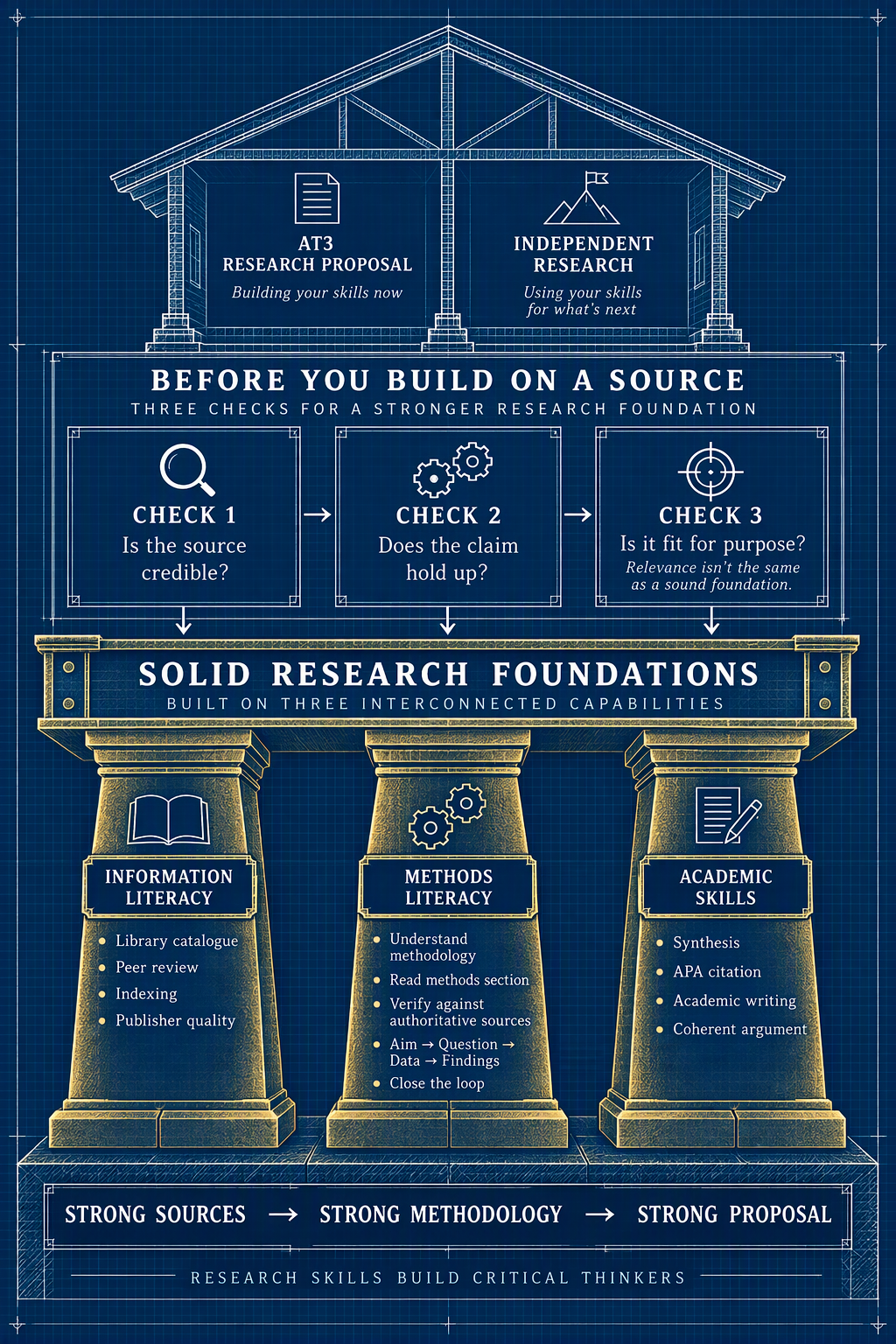
So I started sketching out what those three things actually are: can you tell whether a source itself is credible, can you tell whether what it claims actually holds up under its own evidence, and can you tell the difference between a source that’s relevant to cite and a source that’s safe to build your methodology on. Three checks. It sounds obvious written down like that, but in practice students conflate all three constantly — a peer-reviewed, well-indexed source can still make a claim that falls apart the moment you trace it back, and a source that looks exactly like your own project can still be the wrong thing to model your methods on.
I built this out as a teaching post with a worked example I got a bit obsessed with: the “Learning Pyramid,” the diagram claiming people retain 10% of what they read and 90% of what they teach others. It’s been reproduced in textbooks and training decks for decades, usually attributed to Edgar Dale. Except — and this is the fun bit — two separate peer-reviewed papers actually went back and checked the primary sources. One team read all three editions of Dale’s original text directly and found no percentages anywhere in it. The other traced versions of the pyramid back through archival searches to 1852, more than a hundred and sixty years and decades before the field of experimental memory research even existed. It’s a genuinely great teaching example because it’s not a case of bad research — it’s a case of a claim that survived purely on the strength of being cited, never on the strength of being checked.
Then, because I’m clearly no longer capable of doing anything the simple way, I turned the whole “three checks, one foundation” idea into a diagram — an architectural blueprint cross-section, quite literally: a house with the roof labelled “your research proposal” and “your future research practice,” resting on a beam labelled “solid research foundations,” resting on three pillars for the three literacies. I built one version myself and then ran the same brief through an image generator to see what it produced, purely out of curiosity about how differently two very different tools would interpret the same idea. What came back from the image generator was honestly better looking than my own effort — properly evocative, old-school engraving style — but it took three rounds of catching errors (a fabricated university logo, a wrong year, an invented quote, and at one point the literal word “interconnected” missing its middle E) before it was actually accurate enough to put in front of students. Which, if you think about it, is a nice little recursive joke: I was fact-checking an AI-generated infographic about the importance of fact-checking.
I’m sharing this mostly because I liked how it turned out, and because the Learning Pyramid story is the kind of thing I’ll probably end up telling people at parties. Only because I generally think that they don’t want to know the answer to the question “what do you do”. When they ask this inane question, I nerd bomb them and they never ask me again ::there is actual truth in this::. But there’s a real point underneath the nerdery: the skills that catch a bad source are the same skills, at the same rigour, whether you’re a first-year student building a reference list or someone reviewing for a journal. Teaching that explicitly, rather than assuming it, seems to be the real work this term.

