What I drew at Rage Against the Machines, and why the structure behind AI is fragile and ad hoc.
I drew this sketch while taking notes in the sessions at Rage Against the Machines: Reshaping Australia’s AI Future on 23 November. It had me thinking about the practical questions we face about how we can shape the beast that is re-emerging. That starts with understanding how it actually works, and then identifying the levers.
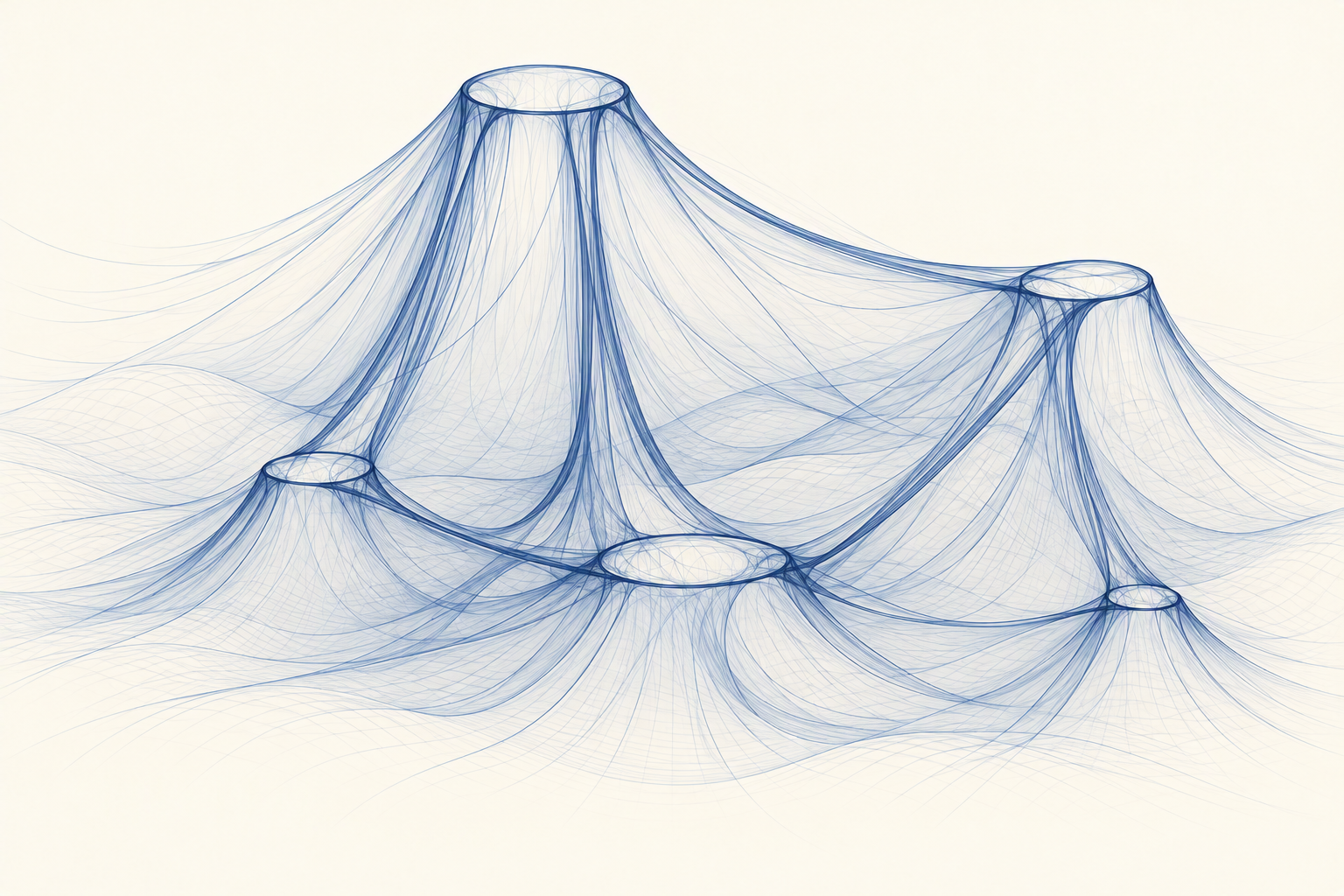
The sketch
One speaker described energy draw as an asset draw that shapes the energy sector and the infrastructures of power. I tried to draw what that sounded like. It isn’t a network of boxes and arrows, and it isn’t a solid block. It’s a canopy held up at a few anchor points, with strands that sag and stretch between them. Beside it I wrote down what was being pulled: share market, copyright, data centres, governance, power and community trust.
I later asked Copilot to interpret the drawing, and its reading was better than my sketch. It saw one continuous fabric that different concentrations of power pull into shape, and noted that the connections sag, stretch and overlap instead of behaving like neat arrows. The keynote framed AI infrastructure through wholism, the sociological frame in which the whole is the sum of its interrelating parts, and I wasn’t convinced. That frame treats the whole as a stable thing with a logic of its own. My sketch is closer to network thinking: anchor points, links between them, and dependencies that can be traced, stretched and cut. And the links aren’t fixed. They are unstable shifts and alliances: governments, investors, chip makers, utilities and AI companies aligning when it suits them and pulling apart when it doesn’t. Nothing holds the whole together except those arrangements, which is why it looks improvised.
The title borrows from Donna Haraway’s Chthulucene, which she named after a spider, Pimoa cthulhu, to describe tangled, tentacular entanglements rather than a single monster. I’m using it loosely. From outside, the data centre build-out looks like Lovecraft’s Cthulhu: one vast thing with a will of its own. From inside the sketch it is closer to Haraway’s: many strands, held together only by what each one depends on.
One thread, followed
Here is a thread I can trace from the public record. The ABC reported on a Treasury briefing, obtained under freedom of information, saying any major Anthropic investment in Australia would depend on clarity of copyright settings. The Australian Financial Review later reported that Anthropic won’t train its models in Australia until there is a regime that lets it pay for content rights. And in September the ABC reported that Anthropic had signed its first Australian deal, for part of a $32 billion data centre near Dalby in Queensland. It would have a power draw comparable to about 1.5 million households, and would sit near existing gas-fired power stations. A local group is worried about gas and about the region’s aquifers. The lease needs Foreign Investment Review Board approval, and the local mayor said it was not yet a done deal because the application was still before the council’s planning team.
A debate that looks like it is about the wording of a 1968 law ends up about land, water, power and whether a community trusts what is being built. Every link in that thread is conditional: a copyright settlement that hasn’t been made, a council approval, a foreign investment review, and a dispute between Queensland and the Commonwealth over what energy should power new data centres. The ABC understands the Dalby site would serve Claude rather than train it. That suggests, and this is my inference, that the physical burden and the intellectual property deal are being negotiated as one package even though they are different things.
The market shows the same instability. On 21 October, NextDC, Australia’s largest listed data centre developer, lost about 42% of its share price in a day, after cutting its earnings guidance. It had customers and contracts. What it lacked was power: the distributor Jemena had suspended grid upgrade work for NextDC’s M3 site in Melbourne citing safety concerns, lost site access amid community opposition, and a council that hadn’t approved taller poles, and told the company it didn’t plan to restart before February. A month later, shareholders voted against its pay report for a second year. One company is answering to investors, a power distributor, planning authorities, customers and the neighbours, and those masters don’t pull in the same direction. That is what an alliance that keeps shifting looks like from the inside.
The detail shows how many joints there are. Residents near the M3 site blocked access with bins and cars when Jemena tried to install taller power poles, according to Yahoo News, and the crews retreated. Reports differ on the height: the Guardian says 22 metres, up from 11 today, while Yahoo says 15. Victoria’s EPA had already issued NextDC an improvement notice over noise in June. And the state planning decision on the next stages of the site slowed because the Victorian government was heading into caretaker mode before the 28 November election, with NextDC’s chief executive expecting February 2027 at the earliest. NextDC now says the expansion is pushed back to the 2027/28 financial year. Some residents, a regulator, a council, an election calendar and a distributor’s schedule have between them slowed a listed company’s build.
Where the power comes from
The scale is easier to see in one number. The ABC reported that the proposed Dalby development, by developer Zerra DC, would peak at 2.16 GW and could draw about 47 GWh a day when fully built, against a Queensland daily average of 170 GWh. By my arithmetic that is about 28%, which the ABC rounds to a quarter. The developer plans to connect straight to a major substation rather than the local network serving nearby towns, and the application still has to get through the Western Downs council, a process that could take years. Over the top is a split the ABC describes: the federal government wants renewables as the national standard for data centres, while Queensland and the Northern Territory are pushing for gas or coal. A farmer who has lived through coal seam gas asks what lasting benefit the communities absorbing the impacts will see.
Who gets a say is also unsettled. The Conversation’s explainer says there is no consistent national framework for regulating data centres, and only standard planning processes apply. Queensland, Western Australia and the Northern Territory have no dedicated policy, so applications can end up assessed as warehouses or general industry. The federal “causer pays” idea, that operators offset their energy use with new renewables, is rejected by Queensland and the Northern Territory, and would not cover existing sites or the 200-odd centres already in planning. On siting, the authors say communities can’t really decide where a data centre goes, and in NSW and Victoria state processes can bypass councils. But submissions still count. In NSW a development with more than 50 submissions goes to the Independent Planning Commission, and a Lane Cove West proposal drew more than 374, nine of them in support.
The Guardian’s reporting from May shows how that plays out on the ground. Maribyrnong council opposes the M3 expansion but is waiting on the Victorian government’s decision. By the end of 2027, if fast-track approval comes, the site would double to 10 hectares and draw 225 MW, with diesel generators reportedly rising from 40 to 100. In Lane Cove, Sydney, a proposed 90 MW centre would be the fourth in the area, where data centres already take up 40% of the local industrial zones, and the council says it exceeds height limits. In Hazelmere, Perth, a planned 120 MW centre is near the Helena River, and the chair of the Bibbul Ngarma Aboriginal Association says the Noongar people have grave concerns about its impact on the river. The industry body’s answer is that if Australia doesn’t build this infrastructure, it will import someone else’s technology with no Australian laws or values built in.
The money and water strings are visible too. The same piece says up to 65% of investment in Australian data centres goes on computer equipment, mostly to overseas chip makers, with about 5% going to grid capacity. Once running, the facilities earn margins around 50%, and the owners it lists include Blackstone, foreign pension funds, the Future Fund and big super funds such as AustralianSuper and UniSuper. That puts super fund members inside the capital string, which is my inference and another place to lean. On water, it says Sydney Water expects data centres to go from about 1% to 25% of the city’s daily demand within a decade, while Amazon plans a Melbourne data centre cooled with recycled wastewater.
Globally, a 2026 UN University report (Aczel et al.) puts data centre electricity use at 448 TWh in 2025, with 945 TWh projected by 2030. The IEA’s figure for 2024, as reported by The Conversation, was about 415 TWh, so the two sit in the same range. Projections like this deserve caution. Masanet and colleagues found that between 2010 and 2018 computing output rose about 550% while energy use rose only about 6%, and some older headline claims were wildly off. I’d treat any single number as an estimate and look instead at where the new demand gets plugged in.
The scramble for power is making the structure stranger, not more solid. Waiting years for a grid connection is now the main constraint, so some developers have turned to retired aircraft. The New York Times reports that engines are being stripped from planes in Arizona’s desert boneyards, converted to burn gas and sold as generators, with xAI running converted units in Mississippi. An analyst quoted there says developers can have a data centre running in about 24 months this way, against years of waiting for the grid. That is a new set of dependencies, running through engine lessors, converters and gas supply. It is also an opening. Environmental groups have challenged xAI’s permits, and the report says the Trump administration has argued that citizens’ suits like that should not be allowed. Google, meanwhile, says it is waiting for grid-connected power. These are different bets by different players, and each runs through a regulator, a supplier or a community.
The same pattern is visible overseas. In Louisiana, a Meta campus that began as a $10 billion project is reported to have grown to $50 billion and about 5 GW. The financing reportedly lets the company leave after four years, while ratepayers carry gas plants built to run for forty, and state regulators declined to look closer. Where one jurisdiction pushes back, a project can move to a place less able to refuse, which is the relocation leverage Velkova describes. That is why the strings are uneven: leverage is real, but it depends on where you stand.
None of this means extraction isn’t a logic. It is, and it repeats from boom to boom. But a logic repeating across arrangements is not the same as one structure holding them together.
The monolith is the illusion
I wrote down a line from the day: to rage against a surface is to rage against an illusion. The surface here is the appearance of a monolith, an inevitable machine with a will of its own. One of the day’s own conversation prompts asked whether the direction of AI is inevitable or the story we’re being sold. Underneath the surface is a chain of specific choices. NVIDIA designs the chips, TSMC fabricates them, ASML has the machines to make them, and every data centre needs power, capital, land and permission. Each of those is a company, a contract or a decision, not a law of nature.
Velkova’s work on data centres as impermanent infrastructures makes a similar point at the level of the building. The monumentality of the site conceals how contingent it is, and the threat to relocate is itself leverage over governments. A structure that looks permanent is often one that is easy to walk away from.
When people say “broligarchy” now, they usually mean a scene. At Trump’s second inauguration, Musk, Zuckerberg, Bezos and Pichai sat ahead of his own cabinet nominees, and Musk went on to lead DOGE beside the president, as Burrows notes. That is a public display of alignment, and it shows a US picture of how AI and state power fit together. It is different from the quieter embedding Burrows describes, where firms like Palantir work through procurement contracts and the hiring of officials. One is visible and the other mostly isn’t. I’ve argued before that stories of shadowy figures pulling our digital strings make a varied space look more coherent than it is, and I still think so. A display of alignment tells you who is allied in Washington. It says nothing about whether a council in West Footscray will approve a power pole.
Another point I wrote down is that the harms of technologies don’t land where they are built. The place a force starts, the place power accumulates and the place the consequences are felt can be entirely different. That is part of why it looks like a monolith from any one position: you only see the part that lands on you. But fragility cuts the other way. A structure held up at a few points has points where you can push.
So what do we do?
The best answer I noted came late: agency means to avoid, elude, resist, stop and redirect, rather than simply refuse or reject. If the structure is made of shifting alliances, those are all ways of working on specific joints: a council submission, a disclosure requirement, a copyright setting, a community that can see itself in what is being built. Alliances can be joined, contested or broken.
In my sketch the strings are flows: power, resource, built environment, capital, labour and regulation. Each has someone holding the anchor and a place where it can be pulled. Power runs through grid operators and their approvals, which is where Jemena’s power poles stalled. The built environment runs through land, zoning and councils. Capital runs through investors, share prices and financing. Resource covers chips, water and the materials of the build. Regulation includes copyright settings, environmental notices and disclosure rules. Labour is the one I have said least about here, and I want to look harder at it. It seems to me the whole build-out is oriented to scale and energy intensity, so every string is being pulled tighter at once. That is also why a single lag, like power for NextDC, can bring the rest down.
I don’t have a tidy conclusion. I do have a better question than the one I started with: not what to rage at, but where this thing is held up. Because the structure is fragile and built from shifting alliances, intervention doesn’t have to be total. It can happen across the weak points and the dependencies, wherever one party leans on another, and that is where I’d want to work.
Sources
[Note: I’ll integrate all of these as hyperlinks later. Items without a link below are not yet linked.]
- Copyright law is now the biggest battleground in Australia’s AI boom, ABC News, 14 July 2026
- Anthropic joins OpenAI in government copyright stand-off, Australian Financial Review, 18 September 2026
- AI giant Anthropic signs agreement for $32b Queensland data centre, ABC News, 16 September 2026
- Australians also don’t like data centers: NextDC shares fall 42%, Fortune, 21 October 2026
- Data centre developer’s shares plunge after backlash, AAP, October 2026
- Australia’s NextDC faces ‘second strike’ on pay report, Reuters, 20 November 2026
- Trump critics say inauguration optics show oligarchy in action, Al Jazeera, 21 January 2025
- Roger Burrows, On Palantirism, Justice, Power and Resistance, 2026
- Grace Nakamura and Brandon Long, Australia’s largest proposed data centre could draw a quarter of Queensland’s energy use, ABC Southern Qld, 14 September 2026
- Josh Taylor, Australia’s largest datacentre operator NextDC’s shares dive as Melbourne expansion delayed, The Guardian, 21 October 2026
- Michael Dahlstrom, Residents woken up by banging at 2am and ‘persistent’ humming as Aussie suburb plagued, Yahoo News Australia, 19 November 2026
- Hiroko Tabuchi, Old, Polluting Jet Engines Are Being Scavenged to Power Data Centers, The New York Times, 3 November 2026
- Aczel et al., UN University report on data centre energy, land and water use, 2026 (details to confirm)
- Meta Hyperion, Louisiana: sources cited in my draft article (Blum 2026; Gulf States Newsroom 2026; Goldman 2026; Union of Concerned Scientists 2026; Liu 2025), originals to confirm
- Julia Velkova, Data Centres as Impermanent Infrastructures, Culture Machine 18, 2019
- Eric Masanet, Arman Shehabi, Nuoa Lei, Sarah Smith and Jonathan Koomey, Recalibrating global data center energy-use estimates, Science, 2020
- Beth Whitehead, Deborah Andrews, Amip Shah and Graeme Maidment, Assessing the environmental impact of data centres part 1: Background, energy use and metrics, Building and Environment 82, 2014 (background, not cited in text)
- Fred Turner, The Texan Ideology, The Baffler, June 2026 (context, not cited in text)
- Nicholas Gane and Roger Burrows, Sociology and the Politics of AI: The Sovereign Individual Revisited, Sociologica 20(2), 2026 (context, not cited in text)
- Harrison Smith and Roger Burrows, Software, Sovereignty and the Post-Neoliberal Politics of Exit, Theory, Culture & Society 38(6), 2021 (context, not cited in text)
- Alexia Maddox, Insider and Outsider Cultures in Web3, 2024 (context, not cited in text)
- Data centres in Australia: your questions answered, The Conversation, 14 September 2026 (Olivia Shen, Jacqueline Boaks, Bronwyn Cumbo, Sarah Barns, Amir Karton, Andrew Cullen, Ian Wright, Ehsan Noroozinejad and Frank den Hartog)
- Josh Taylor, Under a cloud: the growing resentment against the massive datacentres sprouting across Australian cities, The Guardian, 3 May 2026
- Donna Haraway, Staying with the Trouble: Making Kin in the Chthulucene, Duke University Press, 2016

