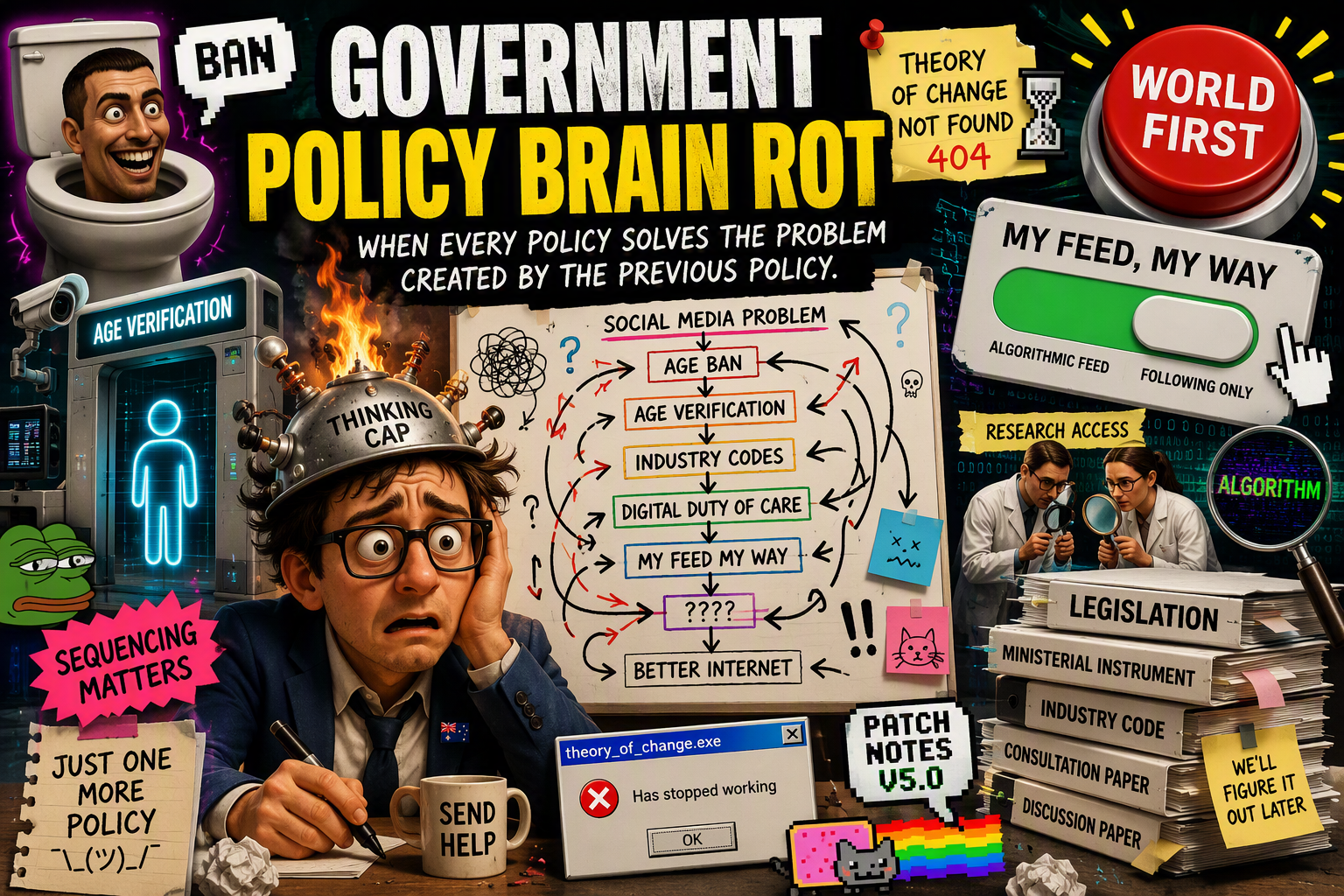
I want to be careful about what kind of post this is, because it isn’t the same kind of post as “Another Day, Another Declaration.” That one was about a newsletter dressed up as a victory lap for evidence that didn’t support it. This one is different. This is the moment the actual strategy becomes visible — not another announcement to catalogue, but the point where you can finally see the shape of the thing the government has been building toward, and ask whether it hangs together.
It doesn’t, and I want to show my working on why.
What actually landed
On 8 September, Anthony Albanese and Anika Wells announced the draft legislation for the Digital Duty of Care bill including an “Australian first” called My Feed, My Way.
Social media platforms will have to notify users of a choice, according to the press release: opt in to an algorithmically curated feed, or opt out and see only the accounts they follow, in order. That’s the government’s stated intent, not yet the law’s text. What the bill itself creates is a ministerial power to require “user empowerment tools” by legislative instrument — the notification, the two named options, the commitment to “respect that choice,” none of it is written into the Act. It’s a promise about how that power will eventually be used, made at the press conference rather than in the clause.
The parts that are actually drafted, and drafted specifically, are elsewhere. Under-18 protections extend into design features — addictive mechanics, self-esteem effects — and into content categories: eating disorder promotion, misogynistic material, pornography, crime glorification, content causing serious mental health distress. eSafety gets removal powers over nudify apps, a streamlined cyber-abuse scheme, and — this is the part with actual teeth — the power to use registered researchers and its own investigators to test, directly, what platforms are serving users, rather than relying on platforms to self-report. Penalties run to $109.2 million, per the government’s own figure. Legislation — still only an exposure draft, open for “targeted consultation” — is promised to be introduced before year’s end.
Read on its own, it’s a reasonable, even overdue, piece of platform accountability. Read in sequence, it’s the fourth or fifth distinct policy instrument Australia has produced on this issue in under two years, and each one was built to solve the problem the previous one created or failed to solve. That’s the part worth sitting with.
I wanted to ask a few questions even at this point so I’ll drop them in here as a by way and then get back in track with the analysis via the theory of change discussion.
Who the “registered/approved researchers” actually are — as far as anyone can currently say:
The bill’s own definition, once you read it rather than the press coverage of it, is narrower than “such as those from an Australian university” implies. Section 205B doesn’t offer university employment as an example of who might qualify — it’s a strict, three-part gate: to be an “approved researcher” you must (a) be employed by an Australian university, (b) be individually approved by the Commissioner under legislative rules, and (c) meet whatever other requirements those rules end up specifying. Independent researchers, journalists, and civil-society investigators are categorically excluded by definition, not just underrepresented in practice. The research itself has to clear a further bar too — approved by a university ethics committee and “of a kind prescribed by the legislative rules to be in the public interest,” a phrase that, like almost everything operational in this bill, is a placeholder for rules that don’t exist yet.
And the access itself is a power to create a scheme, not the scheme. Section 205C says the legislative rules “may” establish one or more “data access schemes” requiring platforms to hand data to approved researchers — what kinds of data, for what kinds of research, under what process, at what cost to the researcher, is all left to future rule-making. Nothing in the Bill as drafted actually obliges a platform to hand anything over yet. The sock-puppet power fares slightly better on specificity — sections 205G to 205L spell out clearly that both approved researchers and the Commissioner personally may assume false identities to create accounts, observe and download material, test platform features, and probe how a service responds to particular actions, with good-faith immunity from civil action built in. That’s genuinely detailed, operative law, not a placeholder — worth distinguishing from the data-access side, which is still almost entirely promissory.
This is functionally Australia’s version of the EU DSA’s Article 40 “vetted researcher” scheme, which is worth naming as a direct comparator, because that scheme’s actual track record is a caution, not a template to feel reassured by. EU vetted-researcher status is notoriously slow to grant. The Delegated Act specifies an 80-working-day decision window — and even well-prepared applicants routinely fail: a Dutch team with prior European Research Council pilot experience on Article 40 implementation, investigating TikTok’s role in Romania’s contested 2024 election, still failed on five of seven eligibility criteria. Eligibility is nominally broad, extending to universities, non-profits and civil society researchers, but studies of the first wave of applications found platforms rejecting requests via narrow readings of “systemic risk,” excluding non-academic applicants in practice, and handing over incomplete data even once access was granted.Australia’s version adds its own extra layer of narrowness on top — the university-employment requirement is tighter than anything explicit in Article 40 — while leaving the actual data-access obligation exactly as undefined as the EU’s was at the equivalent stage. If Australia copies the label without copying — or improving on — the implementation detail, “approved researcher” risks becoming exactly the kind of unresolved gap Josh Taylor flagged with the opt-out mechanism itself: real on paper, undefined in practice, left for platforms and regulators to fight out later.
On the AIO —parallel timing
A Conversation piece published back in July — “Australia wants a ‘digital duty of care’. But how will we check what Big Tech is doing?” — presented the argument from Australian Digital Media researchers that the duty of care needs an “ecosystem of observability” combining three things: regulatory powers to compel platform data, independent research infrastructure (data donation, browser/mobile measurement, secure research environments), and stronger individual rights for Australians to access, download and donate their own platform data. They named the AIO directly as “one model for this infrastructure.” So this isn’t two separate efforts converging by coincidence — it’s the same research network pushing on two levers at once: build the bottom-up data-donation infrastructure regardless of what parliament does, and publicly campaign for the top-down regulatory access powers that just showed up in the exposure draft two months later.
During the same week’s coverage: Chanel Contos’s National Press Club appearance and the NSW Government’s urgent September 4 roundtable following the Sydney schoolboy assault allegations are being cited directly by other commentary as part of the pressure that shaped this exposure draft — her “23 minutes to misogynistic content” statistic is functioning as the kind of concrete evidence the researcher-access provisions are explicitly meant to make independently verifiable going forward, rather than something advocates have to keep re-measuring themselves via burner-phone experiments.
And what does “harmful content” mean?
And while we’re here going down byways, there is another point worth pulling from the ADM+S policy brief , because it sharpens the “harmful content” categories in the bill in a way that matters beyond researcher access.
Back in June, before any of this had bill text, ADM+S and the University of Melbourne’s CAIDE published a policy brief responding to the government’s Issues Paper, arguing the duty of care should move “beyond specifying a set of narrowly defined risks to safety… to require platforms to address broader, systemic risks.” Their central worry, laid out as a named case study, was harm-reduction and public health communication — evidence-based outreach on HIV and drug use has a documented history of suppression, account restriction and rejected advertising on these platforms, not through deliberate policy but as “the inevitable by-product of automated content moderation systems trained to identify, suppress and remove adult or offensive content.” They predicted, in writing, that a narrowly-defined risk-based model wouldn’t fix this — “risk” captures potential harms, not the absence of legitimate positive content — and proposed concrete affirmative protections instead: moderation exemptions for government-funded health organisations, expedited review for wrongly suppressed public-health material, regular audits of moderation systems’ impact on health content.
None of that made it into the bill. What section 25C actually contains is a narrowly-defined categorical list — eating disorders, misogynistic content, terrorism, crime, and, among the entries the government didn’t put in its own press release, material that “encourages, promotes, urges or instructs illicit drug use.” That’s precisely the drafting style ADM+S told government, months earlier, wouldn’t protect the harm-reduction communication they were worried about — and the affirmative protections they proposed to fix it are nowhere in the draft. So this isn’t a hypothetical risk a colleague raised after the fact. It’s a predicted, documented harm, from the government’s own consulted research network, that the exposure draft appears to walk straight into
A theory of change that was available, and wasn’t used
Now, getting back to where we were in the chronological chain of events. Here’s the thing that gets lost every time this gets reported as a fresh initiative: the design-first version of this reform already existed, in 2024, before the account ban was legislated. Zoe Daniel’s private member’s bill on platform duty of care predates the Social Media Minimum Age Act. It was left to lapse. The government reached for the ban instead — a chain that started with a South Australian premier’s Mother’s Day 2024 social media announcement and a News Corp campaign the following week, gathered momentum through the year via other state premiers and an opposition election promise, and culminated in legislation drafted, introduced and passed in under two weeks, with a 24-hour public comment window, in the last sitting week before the federal election.
I’ve written before about what that sequencing choice cost in evidentiary terms. What I want to name now is what it cost architecturally. Once the ban passed, an entire enforcement apparatus grew up around it: the Phase 2 industry codes, the age-assurance vendor contracts, the trusted-provider lists, eSafety’s document-demand powers reaching into third-party verification companies. That apparatus is not neutral scaffolding sitting empty, waiting for a better policy to move in. It has vendors with revenue tied to its continuation, a regulator whose newly expanded enforcement muscle (the Online Safety Amendment Bill, moving through parliament the same week) reaches further into that same verification paradigm, and a political constituency built around “world-first” account restriction as the signature achievement.
So when the duty of care — the reform actually aimed at design, not access — finally arrives, it doesn’t land in an empty room where design-first thinking can shape the whole architecture from scratch. The bill does sweep away one layer of the pre-existing apparatus — Schedule 3 repeals the general online content scheme codes entirely, folding content-classification into the unified duty of care. But the age-verification layer this apparatus was actually built around — the Phase 2 codes, the vendor contracts, the trusted-provider lists — survives untouched, with its penalties increased the same week. The duty of care has to be built around that surviving core, not replace it. This isn’t a coherent strategy unfolding in the right order. It’s a good instrument arriving after a worse one has already poured the foundation, and having to accommodate the foundation rather than correct it.
The mechanism undercuts its own justification
There’s a second problem, sitting inside the bill itself rather than in its timing. The government’s language around My Feed, My Way is explicitly universalist — Wells frames it as “basic standards for the online products we use every day,” alongside cars, toys, food. That’s inclusive-design logic: build the protection into the system for everyone, rather than trying to identify and specially protect a vulnerable subset. It’s good theory. Universal design works because the protected state is the automatic one — nobody has to find it, understand it, or activate it. Curb cuts don’t require a wheelchair user to request one.
But My Feed, My Way is an opt-out, not an opt-in. The algorithmically optimised, high-engagement default stays exactly where it is; the protective state is the thing a user has to notice, understand, and deliberately choose. We already know what that produces, because we’ve watched the experiment run. Under oath in the Oakland federal trial last August, Instagram’s Adam Mosseri confirmed an internal Meta document had put uptake of its “Take a Break” feature — designed to interrupt exactly the kind of compulsive scrolling this bill is meant to address — at 1.8%, a figure the company never disclosed even as it publicly touted a 90% retention rate among the small number who’d turned it on. Meta’s own internal research pointed the same direction on a related question: making teen accounts private by default, rather than opt-in, was projected to prevent 5.4 million unwanted daily message interactions. The lesson, from the company’s own numbers, is not subtle — default state decides outcomes; availability of a safer option barely moves anything at all
The EU has required platforms to offer a non-algorithmic feed option since February 2024 — and in October 2025, an Amsterdam court still had to order Meta to fix it, giving the company two weeks to comply under threat of a €5 million penalty. It turned not a multi-month enforcement fight, not just a quick fix. As Bits of Freedom’s Rejo Zenger, who brought the case, put it: “even if users can switch feeds, they cannot set a preferred feed that persists, and the platform continually nudges users back to the profile feed.” Meta disputed the ruling and appealed — and for now, the binding order applies only in the Netherlands, not EU-wide. If the justification for going broad rather than narrow is genuinely inclusive-design thinking, the logically consistent implementation is an opt-in default, which is what the Greens and Chanel Contos have been arguing for. The government chose the version that photographs the same way in a press release but almost certainly won’t behave the same way in practice.
Who this doesn’t reach, and who’s left holding it
And then there’s the population question, which is the one that should worry anyone thinking about this as a child-safety measure rather than a general consumer-choice one. The opt-out applies to users over 16. The government’s own account ban was supposed to mean under-16s aren’t the audience for this at all — they’re not meant to be logged in, so the question of their feed algorithm shouldn’t arise.
Except eSafety’s own evaluation data says otherwise. Three months in, account ownership among under-16s had fallen from 52.4% to 42.1% — real, but partial. Of the children who kept accounts, the platform-by-platform breakdown shows two distinct failure modes, both damning in their own way. On YouTube, nearly half never even got asked to verify their age — no prompt at all. On Facebook, the single most common reason was different and arguably worse: the age already listed on the account was 16 or above, meaning a check did happen and simply accepted a false answer. Instagram and Snapchat sit in between, with “never asked” narrowly ahead of “false age accepted” on both. Either way, “reasonable steps” is failing at more than one point in the process — not just an absent gate, but a gate that doesn’t hold. Independently, the University of Newcastle’s BMJ study found more than 85% of under-16s still using restricted platforms at the same three-month mark.
Meanwhile the adults meant to be managing all of this — parents and teachers — have less visibility than they had before, not more. eSafety’s own evaluation found parental awareness of children’s social media use actually declined after the ban took effect, concentrated among parents of girls and 10–12 year olds. Teachers, who inherit whatever happened in a student’s feed the moment it walks into a classroom the next morning, get no new tools at all in this bill — the digital literacy and relational-education infrastructure that would let schools and families actually build capability, rather than just manage fallout, isn’t part of the package. It’s the same gap Lisa Given flagged about the earlier duty of care consultation: real teeth on paper, aimed at platforms, with nothing resourced for the people standing between the platform and the child.
The generational bet nobody has actually defended
There’s a longer-run theory of change sitting underneath all of this that almost never gets said out loud, and I think it deserves to be dragged into the open, because I’m not convinced it survives contact with the evidence we already have.
The theory goes something like this: the ban won’t look like it’s working on the generation that’s already on these platforms, because they were socialised into algorithmic social media before the restriction existed, and restriction always looks like resistance in its first cohort. But the next generation — Gen Alpha, kids who are eight, nine, ten right now — will turn 16 having never legally held an account. For them, the age gate won’t be an imposition on an established habit. It’ll just be an unremarkable fact of childhood, the way not being allowed to drive at twelve is. Robinson, La Sala and Harrison named this directly in their 2025 title: is this a “seatbelt moment” — a restriction that looks costly and contested at first and becomes invisible, uncontested background norm within a generation — or a missed opportunity dressed up as one?
It’s a coherent theory. Seatbelts really did work that way: resistance was highest among drivers who’d learned to drive without them, and uptake became close to automatic once a full generation had never known driving any other way. If social media restriction follows the same curve, today’s dismal compliance numbers — 85%+ of under-16s still using restricted platforms, half of retained accounts never even prompted for age checks — aren’t a verdict on the policy. They’re what a first cohort always looks like, and the real test is what a fully Gen Alpha 15-year-old’s relationship to these platforms looks like in 2032.
But I want to push on two things before I let that theory do any work, because right now it’s operating as an unexamined assumption rather than something anyone has actually argued for or is measuring.
The first is empirical, and it’s sitting in plain sight in the argument over whether “brainrot” belongs to Gen Z or Gen Alpha. The honest answer is both, and how it belongs to both is the point: Gen Z, with full algorithmic platform access, generated and refined this content natively — the irony, the absurdist compression, the in-group signalling. Gen Alpha, meanwhile, absorbed an enormous amount of it into daily vocabulary and offline culture without needing platform accounts of their own to do it. Skibidi Toilet, sigma, rizz — this is a nine-year-old’s vocabulary now, transmitted through older siblings, playground repetition, YouTube (which sits partly outside the restriction architecture), and family devices, not through a personal, algorithmically curated feed. That’s a direct empirical challenge to the seatbelt theory’s core mechanism. Seatbelt norms shifted because the behaviour itself — driving unbelted — has no meaningful peer-transmission pathway once you’re not behind a wheel. Platform culture has an enormous one. Excluding a nine-year-old from an Instagram account doesn’t wall them off from the platform’s cultural output; it just changes the delivery mechanism from direct and individually curated to lateral and peer-mediated. If the goal was a generation genuinely insulated from what these platforms produce, the account ban may be solving the wrong layer of the problem entirely — the content diffuses regardless of who’s logged in.
The second problem is normative, and it’s the sharper one: even if the seatbelt theory worked exactly as advertised, is a childhood spent in what we might call a stigmatised relationship to social media — access as illicit, policed, something you get around rather than something you’re taught to navigate — actually the outcome we want? We have a template for what stigma-based restriction does to adolescent behaviour, from decades of underage drinking and smoking policy, and it isn’t uncomplicated normalisation. It’s secrecy from the adults meant to be guiding you — which is precisely what eSafety’s own data already shows happening, with parental awareness of children’s social media use declining, not rising, since the ban took effect. It’s status economies built around successful circumvention rather than around competent use — TikTok how-to guides on evading TikTok’s own age gate, published on the platform being regulated, are not a normalisation success story, they’re the underground-economy version of the same dynamic. And it forecloses exactly the capability-building the digital literacy argument I made above is trying to protect. A generation that grows up treating platform access as contraband to be smuggled rather than a tool to be taught isn’t obviously better prepared for the platforms they’ll use as adults — a cliff-edge from total exclusion to unrestricted access at 16, with no graduated exposure and no explicit skill-building in between, is a pedagogy problem dressed up as a public health win.
And here’s what makes this a genuine theory-of-change problem rather than just a debate to have later: nobody is actually measuring which of these dynamics is occurring. eSafety’s longitudinal evaluation tracks account status, usage duration, and self-reported wellbeing. It isn’t set up to track cultural diffusion, peer-transmission of platform content among excluded users, or whether the relationship young people have to these platforms is becoming one of literacy or one of stigma. We’re running a generational bet — quietly assuming the seatbelt curve will apply, structuring policy timelines around a 2027–2028 review window that presumes it — without building the instruments that would tell us, a decade from now, whether we bet on the right mechanism at all.
A brief detour through brain rot, because it’s not really a detour
I want to pause on something that looks like a side issue and isn’t, because it’s sitting in the same water as everything above it, and because I keep watching it get used as if it settles an argument it can’t actually settle.
“Brain rot” was Oxford’s word of the year for 2024, and since then it’s been doing an enormous amount of unexamined work in exactly this debate. The trouble is that nobody using the term is using it to mean the same thing. Pull apart the ways it’s actually deployed and you get at least four distinct referents wearing one label: a content genre (the singing toilets, the AI-slop, the absurdist short-form video); a slang register that circulates alongside that genre and, tellingly, migrates into offline speech among children who’ve never held a personal account — which is itself a data point against the idea that account restriction meaningfully insulates a generation from platform culture, since the vocabulary clearly doesn’t need an account to travel; a subjective experiential state, the “fogged-out, low-selectivity” feeling Maxi Heitmayer’s Gen Z interview subjects describe, in which the content is a response to an already-depleted state rather than its cause; and, most recently, a proposed clinical construct — a psychometric “Brain Rot Scale,” explicitly modelled on substance-addiction neurobiology, complete with subscales for Attention Dysregulation, Digital Compulsivity and Cognitive Dependency, tested on an Egyptian convenience sample and explaining a modest 35% of variance, with the authors themselves conceding it hasn’t been validated against any existing measure of problematic internet use. Thoreau, who coined the term in Walden in 1854 “will not any endeavor to cure the brain-rot, which prevails so much more widely and fatally?” meant something different again: not an individual affliction at all, but a society choosing simple ideas over complex ones.
What’s genuinely funny, once you go looking, is that Thoreau didn’t stop at the diagnosis, he named the genre. A chapter later, in “Reading,” he takes aim at the popular fiction of his day, cheap, serialised, mass-produced, and devoured compulsively by readers (TikTok rabbit holes anyone?) he compares to cormorants, “who can digest all sorts of this, even after the fullest dinner.” He even mocks the marketing copy, inventing a title that reads uncannily like a lost brainrot video: “The Skip of the Tip-Toe-Hop, a Romance of the Middle Ages… to appear in monthly parts; a great rush; don’t all come together.” And his diagnosis of what this content does to its readers could be lifted whole into any 2026 op-ed: “dulness of sight, a stagnation of the vital circulations, and a general deliquium and sloughing off of all the intellectual faculties.” Deliquium and sloughing off of the intellectual faculties. Nineteenth-century Thoreau just described the brain-rot feeling, named its genre, mocked its marketing, and diagnosed its symptoms, a hundred and seventy years before anyone thought to build a psychometric scale for it. He even had a theory of supply: “this sort of gingerbread is baked daily and more sedulously than pure wheat or rye-and-Indian in almost every oven, and finds a surer market” — which is just the engagement economy, minus the engagement.
All of which is a nice bit of trivia (and it’s my blog, so good times), but it’s also a useful check on where the seriousness actually lives in this debate. Thoreau could name the genre, mock the marketing, and diagnose the feeling — but he never mistook any of that for a discovered fact about the brain. That’s the distinction the current moment keeps losing. This is Ferguson’s construct balkanization problem, which I cited earlier in relation to Rausch and Haidt, showing up again in a completely different corner of the same debate: a folk category getting formalised into something that reads as diagnostic before anyone has established it’s distinct from constructs we already have names for. A scale with excellent internal reliability tells you the instrument is internally consistent. It doesn’t tell you “brain rot” is a real, discrete thing rather than a relabelling of attention difficulties, compulsive checking and existing problematic-use patterns that already have measures.
And it matters which definition is doing the work, because they don’t point toward the same account of what’s happening, let alone the same fix. Compare three recent, more careful pieces of evidence side by side. The passive-sensing study on adolescent phone use I wrote about last week found that low mood predicts more scrolling the next day — a general, content-agnostic disengagement response, consistent with mood management theory: feeling bad, reach for something that costs nothing. Doomscrolling, the pandemic-era construct, is narrower and arguably runs on a different engine entirely — purposeful seeking of threat-relevant, distressing content, closer to anxious vigilance than numbing, a coping strategy that backfires by compounding the very anxiety it’s trying to manage. And Heitmayer’s brain rot, on his own account, sits closer to the first mechanism than the second: his participants describe seeking out content that makes no demand and carries no threat, the near-opposite of doomscrolling’s compulsive checking of bad news. Three different psychological stories, three different underlying mechanisms, one increasingly interchangeable vocabulary — and each new content cycle seems to arrive with a fresh label rather than a resolved question about whether the last one was even right.
Here’s the useful, if slightly deflating, thing this detour actually tells us. Ask what any of this changes about the case for something like My Feed, My Way, and the honest answer is: less than the discourse implies. The strongest evidence for regulating engagement-optimised feeds doesn’t need brain rot, in any of its four senses, to be real. It’s sitting in independent, peer-reviewed research conducted with Meta’s cooperation: when Facebook and Instagram users were switched to chronological feeds for three months in 2020, as part of Meta’s own Election Study with outside academics, they spent measurably less time on the platforms, “suggesting they had become less compelling” — about as clean a demonstration as exists that the algorithmic ranking isn’t neutral scaffolding, it’s the thing actively manufacturing the engagement everyone is worried about. (The same study found the changed feed didn’t measurably shift polarization or political attitudes — a different question from the one this section is asking.)
That evidence stands regardless of whether “brain rot” turns out to be attention dysregulation, mood-driven disengagement, cultural slang, or nothing distinct at all. Which means that when brain rot gets invoked as the reason we need to act — rather than the algorithmic economics standing on their own — it isn’t adding evidentiary weight, it’s borrowing urgency from a construct nobody has actually pinned down. That’s precisely the move I flagged at the top of this post: evidence handled like a fridge magnet, taken out of the room it lives in and put somewhere it can do a different job. The tobacco analogy one of Heitmayer’s own interview subjects reached for — regulate the industry, don’t just tell the individual to smoke less — doesn’t require anyone to have first proven brain rot is a diagnosable condition. It only requires the engagement economics to be what they demonstrably already are.
All over the shop, precisely
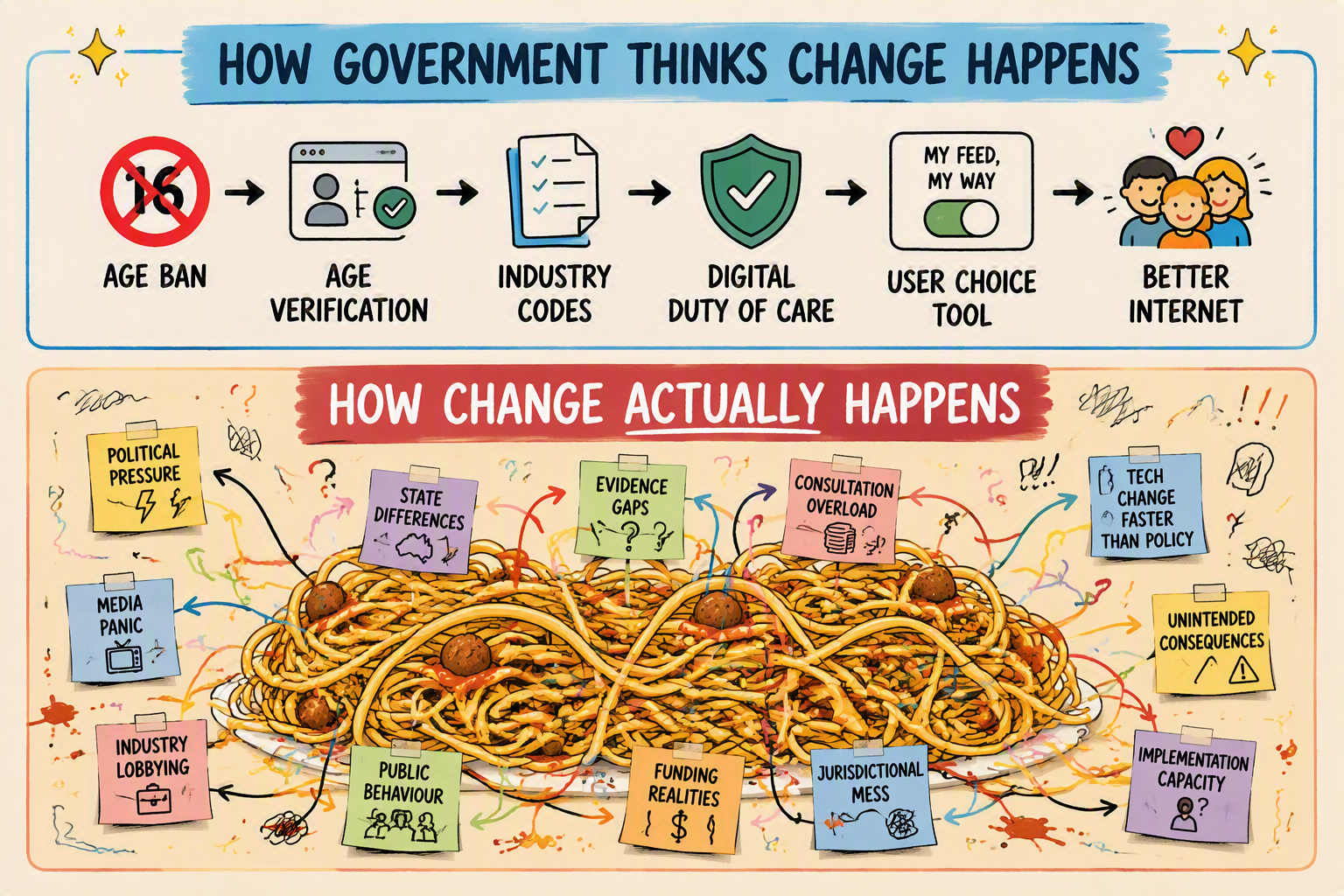
So: is this a coherent theory of change finally showing its hand? I don’t think that’s quite right either, and I want to be precise about the claim I’m making, because “incoherent” undersells it. There have been several theories of change here, each internally sensible on its own terms, arriving in the wrong order and now stacked on top of each other rather than replacing one another. The ban’s theory: exclude the population, protect by absence. The industry codes’ theory: verify identity, gate by age. The duty of care’s theory: fix the system, protect by design, regardless of who’s in it. And running underneath all three, unstated and untested: the seatbelt theory, betting that generational turnover will eventually make the first three retroactively look right, on a timeline nobody has committed to actually measuring. Each of these is individually defensible. None of them were built with the others in mind, because none of them were legislated — or even articulated — in the order a single coherent strategy would have chosen. Design-first was available, and shelved, in 2024.
What we’re watching now isn’t a strategy unfolding. It’s a government retrofitting the reform it should have started with onto infrastructure built by the reform it reached for instead, while badging the least structurally demanding piece of the retrofit — a toggle most users won’t find and Meta’s own numbers suggest they wouldn’t use if they did — as the headline. The eSafety document-demand powers, the researcher testing authority, the requirement that platforms document and maintain their harm-mitigation measures: that’s the part of this bill actually shaped by lessons learned, including from the EU’s own enforcement failures. It’s riding into parliament on the opt-out’s press cycle because it isn’t sellable on its own.
Even that’s only half true, though — the same research network likely got the researcher-access and data-scheme provisions largely adopted, while their central structural recommendation, an outcomes-based duty capable of protecting legitimate content like harm-reduction communication from algorithmic over-suppression, was not. Expert input didn’t fail to shape this bill. It shaped the parts that were easiest to say yes to.
I said in July that it was too early to call the ban a failure, and that cuts both ways — too early to call it a success, too. I’ll say something similar here: it’s too early to know whether the duty of care’s substantive parts survive Senate negotiation intact, or get diluted the way the penalty language already seems to have moved between May’s turnover-linked formula and September’s flat cap. That’s not just a hedge — it’s built into the bill’s own timeline. Schedules 2 and 3, the duty of care itself and the repeal of the old content-scheme codes, don’t commence until twelve months after Royal Assent; only the takedown-notice powers in Schedule 1 take effect immediately. But it isn’t too early to say the sequencing was a choice, not an accident, and that the bill in front of parliament right now is being asked to do the work of correcting an architecture it had no hand in designing.

